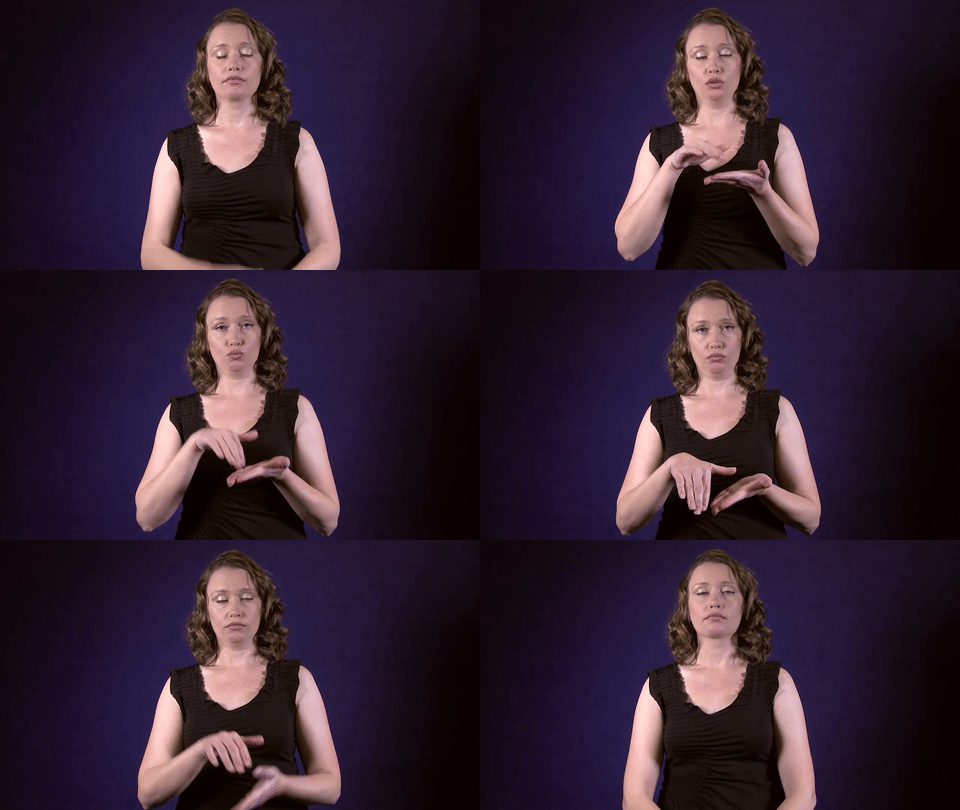
Definition: A polite expression used when needing someone’s attention.
Sign for EXCUSE ME in ASL
Practice Activities:
Start by practicing the sign for EXCUSE ME in ASL in isolation. Repetition will help with memorization and fluidity. Stand in front of a mirror and repeat the sign slowly, focusing on the correct handshape and motion. Gradually increase speed while maintaining clarity.
After you’ve nailed the sign on its own, move into contextual practice. Think of real-life situations where you’d use the sign for EXCUSE ME in ASL, such as walking through a crowded hallway, interrupting someone gently, or getting someone’s attention politely. Act these scenarios out while signing to build confidence in using the sign naturally.
Try practicing with example sentences like: EXCUSE ME, I NEED HELP, or EXCUSE ME, WHERE IS THE BATHROOM? Record yourself signing these and watch to evaluate your accuracy. Create flashcards with the sentence in English on one side and sign the response before flipping to check.
Use storytelling to add depth to your practice. Create a short story where a character needs to excuse themselves several times—stepping over someone’s feet, leaving during dinner, or interrupting to ask a question. Sign the story out loud, emphasizing the sign for EXCUSE ME in ASL where appropriate.
Join a partner activity by pairing with another learner. Take turns acting out brief scenes where one person needs to say excuse me within a social context. The partner watches and gives feedback on clarity and expression.
You can also engage in signing games, such as charades or roleplay, where EXCUSE ME must be incorporated naturally. Reflect on the social norms involved in using this phrase, and match your facial expressions accordingly. Practicing the sign for EXCUSE ME in ASL in varied ways will strengthen both your vocabulary and your cultural sensitivity in ASL interactions.
Cultural Context:
In Deaf culture, the sign for excuse me in ASL carries more than just a polite meaning. It reflects respect, consideration, and cultural norms that prioritize visual attention. When used properly, the sign for excuse me in ASL helps maintain smooth communication and shows a deep understanding of Deaf etiquette.
Using the sign for excuse me in ASL can communicate a variety of intentions, such as interrupting someone, asking someone to move, or apologizing in a respectful way. Because visual attention is key in ASL conversations, requesting that attention be redirected or paused requires a clear and culturally sensitive gesture like this one. It signals your awareness of the other person’s space and focus.
Signed conversations in Deaf culture rely heavily on shared visual engagement. The sign for excuse me in ASL plays an important role in situations where one person needs to enter someone else’s visual space or sign across a conversation. This use of visual politeness keeps interactions from becoming disruptive and maintains community norms.
In crowded settings like Deaf events, classes, or meetings, the sign for excuse me in ASL lets someone move through groups without appearing rude. It lets people know that your actions are intentional and polite rather than intrusive. In this way, it acts much like spoken excuses do in hearing environments, but in a visual form.
The sign for excuse me in ASL is often taught alongside other socially important signs like thank you, please, and sorry. This shows how central manners are to the language and culture of the Deaf community. Signing excuse me demonstrates awareness that communication involves mutual respect, not just vocabulary.
Deaf culture values directness, but this doesn’t mean it’s impolite. The sign for excuse me in ASL is more than just a way to say sorry or get someone’s attention. It’s often a key part of how ASL users maintain smooth social interactions and negotiate shared space visually.
In daily ASL conversations, excuse me offers a respectful way to ask forgiveness or signal need. Whether you’re trying to get by someone in a hallway or cutting into a conversation politely, the sign for excuse me in ASL provides a culturally appropriate way to do so. It keeps interactions considerate in environments where eye contact and facial expressions play major roles.
It’s important to use facial expressions appropriately when signing excuse me in ASL. Your facial expression can show whether you’re asking for space, interrupting gently, or expressing apology. These subtle cues help others understand your intention clearly, which is essential in ASL communication.
For ASL learners, understanding when and how
Extended Definition:
The sign for excuse me in ASL is a useful and polite expression frequently used in social interactions. This sign helps convey manners, gain attention, or apologize in a respectful way. Whether you’re navigating through a crowd or trying to politely interrupt someone, this sign plays an essential role in everyday ASL conversations.
To make the sign for excuse me in ASL, use the dominant hand in a flat handshape. Gently slide the fingertips across the palm of the non-dominant hand. The motion mimics a soft, sweeping gesture, symbolizing the act of politely requesting attention or forgiveness. ✋
The sign for excuse me in ASL can be adapted depending on the situation. For casual interactions, the movement may be subtle and quick, while in more formal contexts, a more deliberate motion conveys sincerity. Facial expressions also add important context, reinforcing politeness or the need for attention.
This sign isn’t limited to one specific situation. You might use it when you accidentally bump into someone, want to ask a question during a meeting, or need to get through a tight space. It’s versatile and greatly appreciated in both Deaf and hearing environments.
In conversations with Deaf individuals, using the sign for excuse me in ASL shows respect for cultural norms. Manners are especially important in ASL, where signs and facial expressions work hand in hand to create meaningful communication. This sign is one of the most important tools for polite interaction.
Teaching children the sign for excuse me in ASL is an excellent way to introduce them to sign language and basic etiquette. Parents and teachers often include this sign in early learning settings because it encourages good manners and social skills.
When learning the sign for excuse me in ASL, it’s helpful to observe it in real-life situations. Watching native signers use the sign during conversation provides valuable insight into its rhythm, expression, and tone. Video dictionaries and signing communities are great places to see the sign in context.
It’s not uncommon to encounter slight variations in regional usage. However, the basic structure of the sign for excuse me in ASL remains consistent across most communities. If you’re unsure, asking a native signer or checking with a trusted ASL resource is always a good idea.
Some people also use the fingerspelled version when they are not familiar with the official sign. While fingerspelling excuse me is acceptable in emergencies, using the actual sign for excuse me in ASL is far more fluid and culturally appropriate.
Understanding how and when to use this sign can make
Synonyms: pardon me, sorry, forgive me, I beg your pardon, excuse
Educational resources: Find related learning materials in our course bank!
Want more? Check out some of our popular learning activities on the homepage!
Need to look up a sign? Use our highly rated dictionary: https://aslinteractive.com/best-asl-dictionary/
Follow us on tiktok: https://www.tiktok.com/@aslinteractive. More social media links at the bottom of this page!
Long-tail Keywords: what is the sign for excuse me in ASL, how do you say excuse me in sign language, how to sign excuse me in American Sign Language
Categories:
tags: excuse me ASL, excuse me American Sign Language, how to sign excuse me in ASL, excuse me sign language translation, ASL dictionary excuse me
Parameters
*Handshape*:
The handshape used in the sign for EXCUSE ME in ASL features a flat, open dominant hand with fingers together, resembling the “B” handshape. The non-dominant hand also opens flat and acts as a base, palm facing upward.
To form the sign for EXCUSE ME in ASL, the fingertips of the dominant “B” hand gently brush or slide across the fingers of the non-dominant hand once or twice. This motion represents a polite request or apology with soft contact between the hands.
*Palm Orientation*:
The palm orientation for the sign for EXCUSE ME in ASL involves the dominant hand open with the fingers slightly curved, palm facing upward. The base hand lies flat with the palm facing up as well, acting as a surface.
The moving hand gently slides across the stationary hand in a forward motion. This palm orientation is essential in conveying politeness and respect in the sign for EXCUSE ME in ASL.
*Location*:
The sign for EXCUSE ME in ASL is made at the flat, non-dominant hand, which is held horizontally at chest level with the palm facing up. The dominant hand, in a bent handshape, makes a gentle sliding motion across the fingertips of the non-dominant hand, moving outward.
This sign is performed in the neutral space in front of the chest, which helps maintain clear visual communication. When using the sign for EXCUSE ME in ASL, make sure the motion is polite and respectful, as it reflects courteous intent.
*Movement*:
To perform the sign for EXCUSE ME in ASL, start with your dominant hand in a bent “flat hand” shape, palm facing up. Place the fingertips of that hand on the palm of your non-dominant flat hand, which also faces up.
Slide the dominant hand’s fingers forward in a small arcing motion across the non-dominant palm. The movement should be gentle and smooth, showing polite intention. The sign for EXCUSE ME in ASL conveys apology or the need to politely get someone’s attention.
*Non-Manual Signals*:
When demonstrating the sign for excuse me in ASL, maintain a slight head tilt forward to show politeness and intent. Paired with a soft, apologetic facial expression—raised eyebrows and a small smile—this communicates courtesy or a gentle request for attention.
Consistent eye contact is key during the sign for excuse me in ASL, emphasizing sincerity. If asking to pass by someone, combine the gesture with a quick nod to further express respect.
*Prosody, Dominant/Non-Dominant Hand*:
The sign for EXCUSE ME in ASL uses a dominant hand in a bent “B” shape while the non-dominant hand remains flat, palm up. The dominant hand moves in an arcing, brushing motion across the fingertips of the non-dominant hand.
This polite gesture emphasizes courtesy and is typically accompanied by appropriate facial expressions. The sign for EXCUSE ME in ASL is versatile and frequently used in social or formal interactions, often to request attention or permission.
Tips for Beginners:
The sign for EXCUSE ME in ASL is common in everyday situations, especially in polite or formal interactions. To master this sign, focus on the handshape and motion. The dominant hand forms a flat “O” or bent “B”, sliding gently across the fingers of the non-dominant flat hand, palm facing up. The movement should be smooth and subtle. This sign can be modified slightly based on context, but the core motion stays the same.
Beginners should practice keeping their movements fluid and not too fast. A jerky or rough motion can look unclear or even confusing. It helps to imagine you’re gently brushing away crumbs from the other hand—this visualization keeps the touch light and polite, in line with the meaning of the phrase. Facial expression is also important; pair the sign for EXCUSE ME in ASL with a sincere or apologetic look when appropriate.
One common pitfall is using too much force or making the movement too large. This can come off as aggressive or incorrect. Also, be careful not to drop your arms too low; keeping your signs at chest level makes them more readable. Make a habit of watching fluent signers to see how naturally they mix this sign into conversations.
To improve accuracy, practice in front of a mirror or record yourself. Watch for hand placement, angle, and how your facial expressions match the meaning. Even though it’s a simple sign, consistency and clarity matter. You can also use signs like PLEASE or SORRY in tandem depending on the situation for more expressive communication.
Finally, try using the sign in real-world situations, like passing by someone or needing to get someone’s attention respectfully. With enough practice, you’ll become more confident using the sign for EXCUSE ME in ASL naturally in everyday settings.
Connections to Other topics:
The sign for EXCUSE ME in ASL has strong connections to signs related to manners, social etiquette, and polite interaction. It is often taught alongside signs like PLEASE, THANK YOU, and SORRY, reinforcing the importance of respectful communication in Deaf culture. Understanding this sign helps learners grasp how ASL conveys social grace and interpersonal norms.
This sign is also useful in constructing more complex or context-specific phrases. For example, it can be combined with directional signs or facial expressions to mean “excuse me, can I pass by?” or “excuse me, I need to ask a question.” In these cases, the hand movement may remain the same, but the context is added through non-manual signals.
A related sign is FORGIVE, which shares a similar handshape and movement to the sign for EXCUSE ME in ASL. Both use a wiping motion across the non-dominant hand, highlighting the conceptual overlap between asking to be excused and seeking forgiveness. This connection helps learners identify patterns in how ASL expresses abstract ideas through similar motions.
In everyday conversation, the sign for EXCUSE ME in ASL can be part of classroom etiquette or public settings. Teachers and students may use it to politely interrupt or gain attention, particularly in group discussions. It can be inserted naturally into classroom-related signs such as QUESTION or HELP, enhancing the overall tone of politeness.
Learning this sign can also lead to deeper understanding of pragmatics in ASL. It offers a starting point for recognizing how body language and situational awareness affect the meaning of polite expressions. Practicing the sign for EXCUSE ME in ASL also builds awareness of when and how to use other courteous expressions, making it an essential part of ASL fluency.
Summary:
The sign for EXCUSE ME in ASL involves a specific palm and movement combination that demonstrates politeness and intentionality. To produce the sign, you hold your non-dominant hand flat, palm up, like a surface. Then you bend the fingers of your dominant hand slightly, brushing them gently across the base of your non-dominant hand in a short forward motion.
The repeated brushing motion signifies deference or a polite request for forgiveness or attention, echoing both literal and figurative meanings. The movement is soft and deliberate, conveying a courteous tone through body language.
Facial expression is crucial with the sign for EXCUSE ME in ASL. You usually pair it with a slight nod or a small apologetic expression to reinforce the request. Without an appropriate expression, the meaning and politeness may be lost or misinterpreted.
This sign typically functions as a way to get someone’s attention or pass by physically in a limited space. It reflects social etiquette and honors personal boundaries. Native ASL signers often emphasize that unwritten social rules are built into such common signs.
In ASL grammar, the sign for EXCUSE ME is often used independently as a complete utterance. Depending on context, it may act as a polite interjection or a subtle way of softening a social interaction. It does not require additional signs to be understood, especially in informal exchanges.
In formal language use or adult interactions, the sign for EXCUSE ME in ASL also serves broader functions, including interruptions, requests for space, or incidental apologies. It’s frequently found in medical, educational, and public contexts where navigating politeness is a part of daily communication.
Children learning the sign are often taught it in conjunction with other signs like PLEASE and THANK YOU. These form a trio of manners signs commonly introduced at early ages. They frame cultural values such as respect and social grace.
In terms of morphology, the sign for EXCUSE ME consists of a contact handshape and repeated movement with directional force. The articulation depends on careful hand positioning and controlled motion speed. The dominance of the hand is also essential, as the passive and active roles of each hand cannot be reversed freely.
Linguistically, the sign reflects ASL’s use of spatial relationships to show intention, making use of handshape, location, and motion to convey nuanced meanings. The brushing motion shows an action being taken to alter a situation gently, which aligns with the semantic core of the word “excuse.”
Applied linguistics studies explore how daily-use signs like EXCUSE ME evolve within deaf communities. For example, some regional variations exist where the sign features a tap or stroking motion with different speed or angle. Understanding these patterns allows for greater sensitivity to dialectal shifts in ASL.
The sign may also be adapted with subtle grammatical or iconic modifications in poetic ASL or performance settings. In ASL storytelling, such motions can be emphasized or drawn out to communicate deeper emotional states, such as embarrassment or remorse. These stylistic modifications serve both narrative and artistic purposes.
Socially, the sign for EXCUSE ME in ASL reflects value systems within deaf culture that heavily prioritize visual etiquette and personal space. Because bumping into someone or interrupting is more visible in ASL than spoken English, clear signs of apology or intent are necessary. This helps preserve harmony and mutual understanding.
This sign may also overlap in usage with other polite signs such as SORRY, though distinctions exist. Where SORRY relates to guilt or regret, EXCUSE ME is more situational and allows for resolution of brief interpersonal moments. Understanding this difference is crucial to interpreting context accurately.
There is sometimes confusion for ASL learners between the sign for EXCUSE ME and signs like FORGIVE or APOLOGIZE. While similar in emotional tone, each has distinct hand configurations and movement styles. The cultural framework for each sign is slightly different, built on different values and uses.
ASL interpreters need to navigate these subtle differences when translating spoken English into sign language. Not every instance of “excuse me” in English warrants the sign for EXCUSE ME in ASL. Contextual cues such as tone and intent often determine whether to use this specific sign or an alternative construction.
In educational instruction, teachers might role-play social scenarios with students to teach the sign for EXCUSE ME in ASL. These include classroom events like raising hands, navigating tight spaces, or interrupting with urgency. Repetition and gesture framing help reinforce the appropriate use.
Culturally, the sign is symbolic of how ASL culture emphasizes clarity and intentionality in communication. Where spoken languages can rely on tone, volume, or even ambiguity, ASL strengthens meaning through simultaneous visual components—handshapes, expression, and body shift.
The historical evolution of the sign shows how borrowings from general hand movements have shaped today’s standardized form. In earlier signs, the brush-and-lift motion may have resembled parts of signs
Want more? Check out some of our popular learning activities!
ASL Interactive Resources
ASLInteractive YouTube Channel
Follow us on tiktok: @aslinteractive.com
Follow us on Instagram: aslinteractive
Facebook page: aslinteractive
Facebook group: aslinteractive
LInkedIn: ASL Interactive LLC
Twitter: @ASL_interactive
*Some information on this page is AI-generated. AI can make mistakes. Please check the information.


Responses