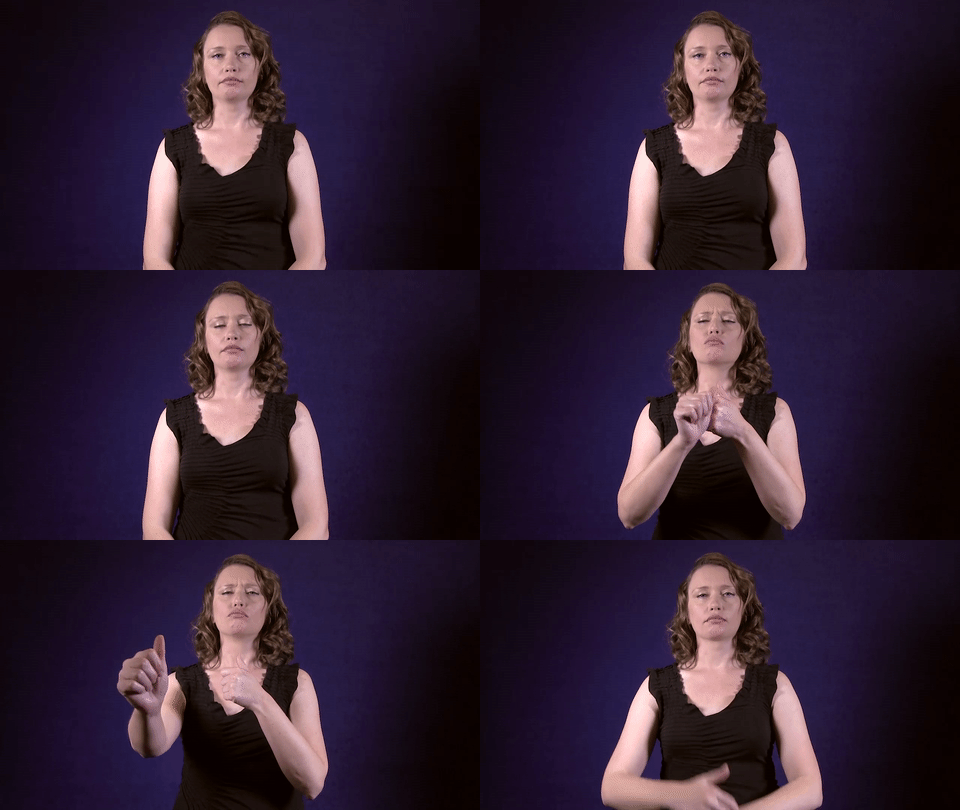
Sign for FAR in ASL | ASL Dictionary

Definition: Located at a great distance.

Sign for FAR in ASL

YouTube player

Practice Activities:

Start your practice of the sign for FAR in ASL by using it in isolation. Sign it slowly while watching yourself in a mirror to ensure accuracy in handshape, movement, and facial expression. Repeat this several times from both your and your viewer’s perspective to understand how the movement appears visually.

Next, transition to short practice phrases. Use simple sentences like “That house is far,” or “The school is far away.” Practice them with varying facial expressions to represent different distances or emotional reactions. Record yourself and play it back to notice areas for improvement.

Try a visual storytelling exercise where you describe traveling from one place to another. For example, explain how you leave your home, walk past a park, and then go all the way to a mountain that is far. This helps integrate the spatial nature of ASL and improves fluency with distance-related signs.

Work with a partner by giving each other scenarios. One person can describe a location, and the other signs the corresponding distance using the sign for FAR in ASL. For example, your partner might say, “How far is the airport?” and you respond by signing “very far” or “not that far,” adjusting intensity and direction as needed.

Use flashcards with images of different locations to prompt sentence creation. For each card, sign one or two sentences describing how far those places are using the sign for FAR in ASL. You could also include directionality to show whether the place is far left, far right, or straight ahead.

Challenge yourself by watching ASL videos that include travel or location-based discussions. Try to identify when the sign for FAR in ASL is used and replicate the sentence in your own signing practice. This builds recognition and context usage.

Cultural Context:

In American Sign Language, the concept of physical and emotional distance is nuanced and deeply embedded in Deaf culture. When using the sign for FAR in ASL, it’s not just about indicating geographical separation—it’s also about storytelling, expression, and making connections through spatial awareness.

Deaf culture places a strong emphasis on visual language, and the sign for FAR in ASL reflects that value. Signing FAR involves extending the arm or showing space between imaginary objects, depending on context. These visual-spatial cues help establish meaning and allow for more vivid communication in both casual and formal settings.

The sign for FAR in ASL may change slightly depending on what is being described. For example, if you’re telling a story and want to emphasize how far someone traveled, you might exaggerate the space or direction in your signing. This technique is culturally appropriate and helps engage the audience, showing how layered ASL can be.

Within Deaf storytelling traditions, the sign for FAR in ASL is used often to set a scene. Whether it’s describing someone walking a long way or a city that’s far from home, ASL users rely on this spatial reference to build a mental image for the viewer. It’s part of what makes ASL a powerful, expressive language.

In conversations, the sign for FAR in ASL isn’t only applied to physical locations—it can describe time or emotional distance too. Someone might sign FAR when talking about a long time ago or an experience that feels distant emotionally. These metaphorical uses are understood through context, thanks to the visual depth of the language.

Deaf children learning ASL pick up the sign for FAR early on, especially because it’s used frequently in everyday communication. Parents and teachers use it to describe destinations, point out objects, or explain timeline events. Its flexibility reinforces both language skills and spatial understanding.

Community-based events often include storytelling where the sign for FAR in ASL appears in dialogue and narration. It adds drama or clarity to describe how far a character journeyed or how long ago events occurred. These uses highlight the cultural richness of ASL as more than just a communication tool—it’s a storytelling art.

In ASL poetry, the sign for FAR in ASL might be combined with facial expressions and body movement to evoke longing or nostalgia. This emotional layering is central to Deaf artistic expression and shows how signs carry both literal and symbolic meaning. These performances deepen cultural ties and connect communities through shared visual language.

Understanding the cultural weight behind the sign for FAR in ASL enhances how

Extended Definition:

The sign for far in ASL is a spatial concept that conveys distance between two points or objects. This sign involves extending the dominant hand away from the body, emphasizing how far one thing is from another. The expression on the signer’s face also plays a key role in showing the degree of distance, with a more exaggerated facial expression often indicating a greater distance.

In American Sign Language, spatial and directional signs like the sign for far in ASL rely heavily on visual placement in the signing space. A signer might begin with both hands closer together and then move one hand outward to show that something is farther away. Facial markers such as squinting or tilting the head can enhance the meaning further, helping clarify just how far the distance is.

This sign is commonly used in conversation to refer to physical distance, such as how far a location is or how long it would take to get there. For example, you might use it when explaining that a friend’s house is far from your own. It can also be paired with direction indicators, like left or right, to be even more specific.

When learning the sign for far in ASL, it’s important to pay attention to the use of space. This concept helps develop a deeper understanding of how ASL conveys more than just vocabulary but also visual relationships. Direction, movement, and expression all work together to form a complete message.

Facial expressions in ASL are not optional, especially when using signs that describe relative distance. A subtle distance might have a soft, relaxed expression, while something very far could require raised eyebrows or a surprised expression. These visual cues help differentiate between meanings that would otherwise look too similar.

Younger learners or new signers may initially struggle with how big the motion should be or how much facial expression to use. Practicing the sign for far in ASL within full sentences can help reinforce its meaning and proper use. For example, pairing it with signs for cities, landmarks, or travel can show both context and intent.

The sign is also useful in storytelling, helping the audience visualize scenes where characters or events take place over long distances. In this context, the action of the sign supports imagination and narrative flow. Teachers and interpreters often encourage students to use exaggerated motions in these cases to maintain clarity and visual interest.

Regional variations in signing might slightly alter how the sign for far in ASL is performed, but the general concept remains the same. Some communities might use slight changes in direction or intensity, while still communicating the same

Synonyms: distant, remote, faraway, outlying, removed

Educational resources: Find related learning materials in our course bank!

Want more? Check out some of our popular learning activities on the homepage!

Need to look up a sign? Use our highly rated dictionary: https://aslinteractive.com/best-asl-dictionary/

Follow us on tiktok: https://www.tiktok.com/@aslinteractive. More social media links at the bottom of this page!

Long-tail Keywords: what is the sign for far in ASL, how do you sign far in American Sign Language, far sign language

Categories:

tags: far in American Sign Language, how to sign far in ASL, distance in ASL, far ASL meaning, far ASL sign explanation

Parameters

*Handshape*:

The handshape for the sign for FAR in ASL uses both hands beginning in an “A” handshape. The dominant hand starts near the non-dominant hand and then moves outward and away from the signer to indicate distance. This outward motion emphasizes space and separation, reinforcing the meaning of the sign for FAR in ASL.

The use of the “A” handshape helps anchor the motion clearly, making it easy to distinguish in conversation. This distinct movement is essential in visually conveying that something is far away in American Sign Language.

*Palm Orientation*:

For the sign for FAR in ASL, the palm orientation begins with the dominant hand in a thumbs-up (A handshape) position, palm facing inward toward the body. As the motion progresses, the hand moves forward and outward from the body, and the palm gradually rotates to face outward.

This shifting orientation helps convey the increasing distance associated with the sign for FAR in ASL. The non-dominant hand may remain at the initial spot for contrast, emphasizing the separation.

*Location*:

The location for the sign for FAR in ASL starts near the body, typically around chest or shoulder level. The dominant hand begins close to the body and then moves outward during the sign, symbolizing something at a distance.

The key movement that defines the sign for FAR in ASL stretches away from the starting point, visually portraying the concept of distance. The direction and extension of the hand away from the torso emphasize how far away something is being referenced.

*Movement*:

To produce the sign for FAR in ASL, start with both hands in “A” handshapes, palms facing one another. Position them close together in front of the body, then move the dominant hand forward in a straight line away from the non-dominant hand, emphasizing distance. This movement shows the concept of increasing space.

In the sign for FAR in ASL, the expression often includes a slightly raised eyebrow or squint to visually support the idea of something being far away. The speed and extension can vary to show relative distance.

*Non-Manual Signals*:

When using the sign for FAR in ASL, the non-manual signals typically include widened eyes and a slight lean of the torso or head backward, expressing distance or extent. The eyebrows may rise slightly, reinforcing the concept of something being located far away .

Facial expressions play a critical role in the clarity of the sign for FAR in ASL, often conveying awe, surprise, or emphasis on remoteness. These subtle cues help distinguish this sign from those that indicate shorter distances.

*Prosody, Dominant/Non-Dominant Hand*:

The sign for FAR in ASL uses the dominant hand in a thumbs-up ( ) shape, starting at or near the non-dominant fist and moving outward, away from the body. The movement demonstrates distance, and the facial expression often includes widened eyes or a slightly open mouth to visually convey how far something is.

Both hands are involved, but emphasis is on the dominant hand’s directional motion. The sign for FAR in ASL varies in intensity depending on how far away the speaker means, which is shown by how far and fast the hand travels.

Tips for Beginners:

When learning the sign for FAR in ASL, it’s important to exaggerate the distance between your hands to communicate the concept of something far away. The basic sign starts with your dominant hand near your body with the thumb up, and then moves outward and away, as if showing something moving a long distance. The further and smoother the motion, the clearer your sign will be. Remember to incorporate appropriate facial expressions to convey distance—showing a squint or raised eyebrows helps reinforce that the subject is far.

One common issue beginners face with the sign for FAR in ASL is not fully extending their arm or not showing enough movement. The gesture requires some space, so be aware of your signing area and avoid making the movement too quickly or too small. Slowing down your hand movement slightly can help show the concept more vividly. If you rush the action or keep your arm too close to your body, the meaning might be lost or mistaken for a different sign.

To master the sign for FAR in ASL, practice in front of a mirror to observe your arm extension and body posture. Emphasizing directionality and fluid movement helps convey the correct meaning. Watching native signers demonstrate this gives you a better sense of speed and nuance. Also, pairing this sign with contextual signs like LOCATION or TIME can help reinforce your intent and improve comprehension in conversations.

Make sure to keep your non-dominant hand relaxed as it generally isn’t used in this sign. Keep practicing this motion in different contexts to build comfort and muscle memory. As you continue using the sign for FAR in ASL in daily conversation, your confidence and clarity will naturally improve.

Connections to Other topics:

The sign for FAR in ASL is connected to numerous spatial and directional concepts. It shares similarities with signs like LONG, DISTANT, and JOURNEY, which require a sense of movement and expansion in space to convey the idea of something being remote or extended. When signing, body language often plays a vital role in emphasizing just how “far” something is—leaning back slightly or using facial expressions to show exaggeration strengthens the sign’s visual impact.

This sign is commonly seen in conversational ASL when discussing travel, distances, or unfamiliar locations. For example, in a dialogue about a road trip or a distant relative, the sign for FAR in ASL can be modified with non-manual markers like widened eyes or a puffed cheek to show great distance. Its visual nature makes it easily adaptable to storytelling and narration in ASL, where spatial arrangement is key to comprehension.

The sign also forms part of compound signs or concepts such as FAR-AWAY PLACE, where the context can adjust how large or small the movement is. Another example is integrating the sign with TIME to indicate something occurring in the far future. These compound uses enrich the vocabulary and show how flexible visual language can be when combined with classifiers or directional signs.

In educational settings, the sign for FAR in ASL helps clarify abstract ideas like emotional distance or remote concepts. It is also useful when teaching comparisons—between FAR and NEAR, for instance—offering a contrast that helps learners grasp spatial relationships. Developing fluency includes understanding these relational dynamics, which underscores how core signs like FAR are foundational to building more advanced ASL grammar and communication.

Summary:

The sign for FAR in ASL typically begins with both hands in an initial close position. The dominant hand starts near the body and then moves outward into the distance, usually away from the non-dominant hand or reference point.

This outward motion suggests not only distance but also detachment in space or time. The facial expression that accompanies the sign usually includes widened eyes or a pursed mouth to visually reinforce the concept of something being far away.

When contextually appropriate, the sign for FAR in ASL can also show exaggeration of distance by deploying further elongation of the sign’s movement. This extended motion can be helpful when emphasizing vastness or emotional remoteness.

In ASL grammar, spatial referencing is crucial. The concept of far involves more than just distance; it involves expressive indexing and space use to indicate relative positioning.

The sign for FAR in ASL is usually directional. This means it can modify and align with specific spatial locations set up earlier in a conversation to indicate where an object or event is happening or happened.

When used in storytelling or narrative contexts, FAR can be used metaphorically or physically. It can describe literal space such as long distances traveled or more figurative connotations of emotional or chronological distance.

The sign for FAR in ASL also aligns with temporal topics. For example, it is used when discussing the distant past or events in the remote future, integrating both time and space in conceptual manner.

In terms of morphology, the ASL sign integrates movement, facial expression, and hand placement. These elements interact linguistically to produce a sign that does more than just reference space—it encapsulates attitude and emphasis.

Native ASL signers often personalize the sign based on emphasis or narrative. The distance the hand moves and the speed of motion can imply levels of perceived distance, further adding meaning.

There’s a strong alignment between the sign for FAR in ASL and conceptual blending theory. Linguistically, it blends spatial and emotional meaning into a single holistic visual expression.

The sign is also sometimes modified to reflect other meanings such as “far away” or “distant” depending on adjacent signs. Context in ASL drives much of the modification in everyday use.

When comparing the ASL sign to spoken English, it becomes evident that ASL visualizes space more directly. Instead of saying “far away,” it is shown physically in signing space with hand movement and gaze.

This visual-spatial strategy is a hallmark of signed languages. The sign for FAR in ASL exemplifies how meaning is formed not just by vocabulary, but by relationship between the signer, space, and referent.

In conversational ASL, the sign for FAR may appear with related signs like CLOSE, NEAR, or LONG WAY. These contextual pairings help shape the sign’s meaning more clearly in discourse.

When using classifiers, FAR can be conveyed through spatial setup rather than a single sign. A classifier showing a small car moving away from a location uses movement and indexing instead of just the base sign.

Grammatically, the sign must follow ASL syntax rules. If used within a sentence, it typically appears after the subject or serves as a predicate modifier, depending on the sentence’s structure.

The placement of FAR can also vary in questions. Facial expressions rise in wh-questions or yes/no contexts, adding layers of grammar around the core idea of distance.

Learners often confuse FAR with the signs for DEEP or LONG because of similar spatial hand movements. However, nuance in motion and handshape keep these signs distinct in meaning.

From a sociolinguistic standpoint, the frequency of using FAR varies by topic and region. In storytelling-rich cultures or families, signers may creatively expand and aromaticize the concept of distance.

Culturally, the sign for FAR in ASL integrates imagery. Deaf narratives and histories often emphasize the journey or separation themes, where the concept of far plays both a physical and symbolic role.

The sign is inherently rich with metaphorical extensions. In ASL poetry or performance, FAR can stand in for longing, life journeys, or absence, making the visual metaphor deeply expressive.

Learning the sign for FAR in ASL offers insight into how ASL imagines and locates things across space and time. It strengthens the signer’s ability to manage visual referents in dynamic positioning.

Eye gaze plays an important role in this sign. The signer often looks toward the direction of hand extension, reinforcing the notion of distance tacitly and visually.

Variation exists among signers in terms of distance expressed. A signer might show FAR in a much more grand motion in dramatic narratives or reduce the form in informal discussions.

Some fingerspelled versions of far appear in technical or academic signing, although rarely. Generally, the core sign prevails in natural discourse.

Children learning ASL often modify the sign shape or scale based on personal perception of distance. Teaching FAR allows development of visualization and conceptual mapping from a young age.

In interpreter training, students are taught to localize space appropriately when

Want more? Check out some of our popular learning activities!

ASL Interactive Resources

ASLInteractive YouTube Channel

Follow us on tiktok: @aslinteractive.com

Follow us on Instagram: aslinteractive

Facebook page: aslinteractive

Facebook group: aslinteractive

LInkedIn: ASL Interactive LLC

Twitter: @ASL_interactive

*Some information on this page is AI-generated. AI can make mistakes. Please check the information.


Responses