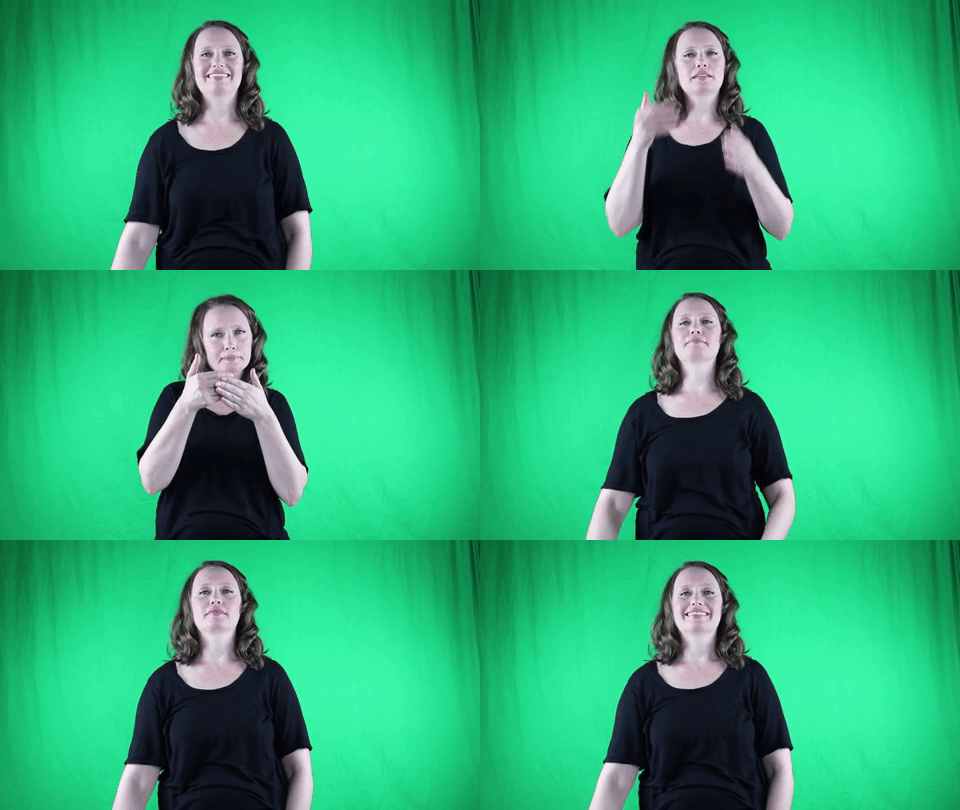
Definition: Close in proximity.
Sign for NEAR in ASL
Practice Activities
To build fluency with the sign for NEAR in ASL, start by practicing in front of a mirror. This helps you monitor your hand placement and facial expressions, which are crucial in American Sign Language. Since the sign for NEAR in ASL involves specific spatial movement between both hands, the mirror allows you to correct any subtle misalignment.
Record yourself signing short phrases that include the sign for NEAR in ASL. Watching your recordings helps you notice timing, expression, and accuracy. You can also compare your version with native signers or online ASL dictionaries to evaluate your performance.
Use the sign in context by describing spatial relationships around you. For example, say “The cup is near the sink” or “My phone is near my computer” using full ASL structure. Repeating these situational uses will help reinforce the sign for NEAR in ASL in your everyday vocabulary.
Advanced learners can practice with signed dialogues or narratives. Include contrasting signs like FAR and CLOSE to develop nuanced control over spatial terms. Engage in interactive ASL games or storytelling with peers to make the sign for NEAR in ASL more natural and fluent.
SEO Cultural Context
The sign for NEAR in ASL reflects more than just physical proximity; it also aligns with how Deaf culture expresses spatial awareness. Deaf individuals often rely on ASL’s rich spatial grammar to show where things are in relation to each other, and the sign for NEAR in ASL is a key part of that system.
In Deaf culture, storytelling and visual description are central communication tools. The sign for NEAR in ASL is commonly used to describe scenes, give directions, or explain relationships between people or objects. It is especially relevant in discussions involving proximity or comparisons.
Regional variation exists, though the most common version of the sign for NEAR in ASL involves the dominant hand moving close to the non-dominant hand, both in flat “B” handshapes. In some areas, slight variations in hand movement or facial expressions may add layers of meaning, such as indicating ‘very near’ or ‘almost touching.’
Understanding when and how to use the sign for NEAR in ASL appropriately also involves observing conversational norms in the Deaf community. Avoid exaggerating movement or overusing the sign out of context, which can come across as unnatural or confusing in a signed conversation.
Extended Definition
The sign for NEAR in ASL typically uses two flat hands in a horizontal position, with the dominant hand moving close to the stationary non-dominant hand. The hands should not touch but come very close, showing the concept of closeness without contact.
This sign is part of a broader group of spatial relationship signs, such as FAR, BESIDE, and IN FRONT OF. These signs often rely on the same palm orientation and handshape but differ in movement and space used. The sign for NEAR in ASL focuses on proximity and is often accompanied by a slight forward movement of the head or a narrowed eye gaze to emphasize closeness.
Common errors include touching the hands together, which changes the meaning, or using incorrect handshapes. Some learners mistakenly use a single hand, but the standard form requires both hands. Facial grammar, such as slightly squinting or tilting the head, adds clarity and should not be ignored.
The sign for NEAR in ASL can also be modified with facial expressions or movement speed to indicate degree. For instance, a faster motion with a serious face might mean “very near” or “almost.” Understanding these subtle differences enhances both expressive and receptive ASL skills.
Tips for Beginners
If you’re just starting out with the sign for NEAR in ASL, take your time learning the correct hand positioning. Use both hands with flat palms and keep them horizontal. Make sure the dominant hand moves toward the non-dominant hand without touching it.
A common beginner mistake is making the hands touch, which actually changes the meaning of the sign. Another error is forgetting to use facial expressions. In ASL, facial grammar is just as important as hand movement, especially for signs like NEAR that describe spatial relationships.
Try practicing with real-life objects. Place two items on a table and use the sign for NEAR in ASL to describe their positions. This helps reinforce the meaning and gives you practical ways to use the sign in daily life.
Don’t rush. Mastering the hand movement and facial cues for the sign for NEAR in ASL takes practice. Be patient, and review videos of native signers to model your signing after theirs. Consistent, focused practice will help you build confidence and accuracy.
Connections to Other Topics
The sign for FAR is a natural counterpart and contrast to the sign for NEAR in ASL. While NEAR involves a short distance between hands, FAR uses extended space and a directional motion. Practicing both together helps reinforce the concept of spatial opposites in ASL.
Another related concept is the sign for CLOSE (as in proximity, not to close something). This sign may appear similar but has a different motion and can sometimes cause confusion. It’s important to distinguish between these signs to maintain clarity.
The sign for NEXT TO is another spatial term that often appears in the same conversations as NEAR. It emphasizes adjacency and is used to describe things that are side by side. Learning both signs helps expand your ability to describe locations and relationships.
IN FRONT OF and BEHIND are also spatial signs connected to the sign for NEAR in ASL. These signs help build a complete mental map when describing a scene or giving directions. Understanding how NEAR fits within this broader system deepens your ASL fluency.
Finally, the sign for HERE is contextually related. It can be used alongside NEAR to emphasize location, such as “The book is here, near the lamp.” Using these signs together allows for richer, more precise communication.
Lengthy Summary
The sign for NEAR in ASL plays a vital role in expressing spatial relationships and proximity in everyday communication. It uses two flat hands, with the dominant hand moving close to the non-dominant hand without touching. This motion, combined with appropriate facial expressions, conveys the idea of something being close in space.
Culturally, the sign for NEAR in ASL fits into the larger framework of Deaf visual communication. It supports descriptive storytelling, map-like explanations, and clear spatial orientation. Understanding how this sign functions within ASL grammar and Deaf norms enhances both your receptive and expressive skills.
For beginners, mastering the sign for NEAR in ASL involves careful attention to hand shape, movement, and non-manual markers. Avoiding common mistakes such as touching hands or using incorrect facial expressions is essential. Use daily practice strategies like mirror work, recording, and contextual signing to make this sign a natural part of your vocabulary.
The sign for NEAR in ASL connects with a wide range of related signs, including FAR, CLOSE, NEXT TO, and HERE. These connections enrich your ability to describe the world around you in ASL and help you develop a more robust understanding of spatial grammar.
Keep practicing the sign for NEAR in ASL regularly, and don’t be afraid to ask Deaf community members or fluent signers for feedback. The more you integrate this sign into real-life conversations, the more confident and accurate you’ll become. Dive into more spatial terms and keep building your ASL fluency, one sign at a time!
Synonyms: close, nearby, adjacent, neighboring, in proximity
Educational resources: Find related learning materials in our course bank!
Want more? Check out some of our popular learning activities on the homepage!
Need to look up a sign? Use our highly rated dictionary: https://aslinteractive.com/best-asl-dictionary/
Follow us on tiktok: https://www.tiktok.com/@aslinteractive. More social media links at the bottom of this page!
Long-tail Keywords: what is the sign for near in ASL, how do you sign near in ASL, near in American Sign Language
Categories:
tags: proximity vocabulary in ASL, ASL signs for directions, ASL spatial concepts, near and far in sign language, positional signs in ASL
Want more? Check out some of our popular learning activities!
ASL Interactive Resources
ASLInteractive YouTube Channel
Follow us on tiktok: @aslinteractive.com
Follow us on Instagram: aslinteractive
Facebook page: aslinteractive
Facebook group: aslinteractive
LInkedIn: ASL Interactive LLC
Twitter: @ASL_interactive
*Some information on this page is AI-generated. AI can make mistakes. Please check the information.


Responses