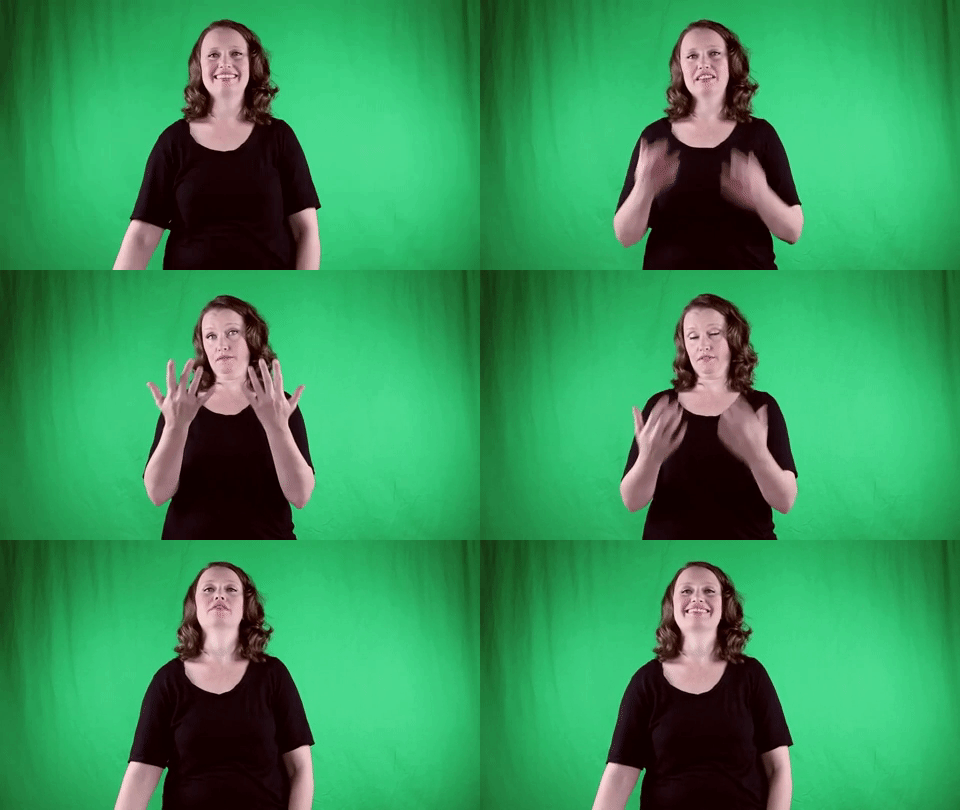
Sign for FIRE in ASL | ASL Dictionary

Definition: The process of combustion.

Sign for FIRE in ASL

YouTube player

Practice Activities:

To practice the sign for FIRE in ASL, begin by repeating the sign in isolation several times in front of a mirror. Focus on the hand shape, movement, and facial expression. The sign uses wiggling fingers moving upward to represent flames rising, so pay attention to the fluidity of that upward motion.

After you’ve practiced in isolation, move on to using the sign in simple sentences. For example, sign “I SEE FIRE” or “FIRE DANGEROUS.” This helps connect the sign for FIRE in ASL to common vocabulary and reinforces grammatical structure. Sign these phrases both slowly and at a conversational speed.

Create a mini-story or scenario where the sign for FIRE in ASL is used multiple times. For instance, you could describe a camping scene where people start a fire, roast marshmallows, and put out the fire at the end. This activity makes the sign more memorable through visual storytelling. Include expressive emotions to reflect the urgency or calmness of the scene.

Partner activities can be valuable as well. One person can act out various situations using signs and the other must identify when the sign for FIRE in ASL is appropriate. Role-playing emergencies versus controlled fire scenarios (like a fireplace) can encourage deeper understanding of context.

Use flashcards with images like a campfire, burning building, or birthday candles. Sign the correct ASL word for each image with emphasis on the sign for FIRE in ASL when it’s applicable. You can also time your practice session with music in the background to simulate speed and improve fluency.

Daily journaling in sign language, using video logs, is helpful. Include a sentence each day using the sign for FIRE in ASL. This repeated use deepens memory and builds expressive skills over time.

Cultural Context:

In American Sign Language, the sign for fire in ASL holds deep cultural meaning beyond its literal interpretation. Fire has always played a vital role in human history, and for the Deaf community that shares traditions in ASL, it represents both danger and warmth, destruction and renewal. The sign for fire in ASL is commonly used in stories, folklore, and conversations about emergencies, safety, and nature.

Because ASL is a visual language, the sign for fire in ASL is expressive, mimicking the flickering and rising motion of flames. This visual imagery allows Deaf individuals to engage with the concept of fire on a personal and interactive level. Whether discussing a campfire, a wildfire, or lighting a candle, the sign captures the physical nature of fire in a way that resonates with ASL users.

In Deaf culture, visual storytelling is a rich tradition, and the sign for fire in ASL is often used in signed narratives to create dramatic effect or indicate urgency. It can symbolize extreme emotion—such as anger or passion—or represent literal fire in a descriptive scene. This versatility in ASL storytelling highlights how one sign can be used in multiple layers of meaning.

When talking about fire drills or fire safety, the sign for fire in ASL appears frequently in educational settings such as classrooms or community workshops. Fire safety is an important topic, and ASL interpreters make sure that the sign for fire in ASL is clear and recognizable to ensure that safety messages are understood. This shows how the language is adapted to keep the Deaf community informed and safe during potential emergencies.

In many indigenous and spiritual traditions, fire is a powerful symbol of life and transformation. Similarly, in Deaf cultural events and shared experiences, the sign for fire in ASL may be used symbolically to reflect intense personal change, rebirth, or celebration. For example, it might appear during storytelling events or within performances that honor these deeper meanings.

The social use of the sign for fire in ASL also appears in everyday conversation. People use it casually when describing meals being cooked, the weather being hot, or an exciting event being described as “on fire.” This natural use of the sign shows how the vocabulary in ASL adapts to modern expressions and idioms.

Whether used in emergency preparedness, poetic storytelling, or daily conversations, the sign for fire in ASL connects people to a deeper cultural awareness. It enriches communication within the Deaf community and introduces sighted hearing people to the richness of ASL. As people continue

Extended Definition:

The sign for fire in ASL uses both hands with fingers spread apart, moving in an upward wiggling motion, similar to how flames rise. It visually represents fire and is easy to remember because it mimics the look of flames flickering upwards.

This sign is often used in storytelling, emergency-related conversations, and discussions about natural elements in American Sign Language. Whether talking about campfires, fireplaces, or even wildfires, the sign for fire in ASL remains the same. Its vivid visual representation makes it especially effective in expressive signing.

Learning how to use the sign for fire in ASL is useful for many everyday and safety-related contexts. You might use it when explaining fire drills, giving safety instructions, or simply talking about lighting a fire while camping. It’s also helpful for interpreting or communicating emergency warnings.

Facial expressions can enhance the meaning when signing this word. For example, a serious or alarmed expression might indicate danger, while a relaxed or happy face could mean you’re discussing a cozy fire or roasting marshmallows . Combining non-manual signals with the hand movement strengthens the meaning.

The sign for fire in ASL can be a standalone concept or part of larger phrases like fire truck, fire alarm, or firefighter. Each of those phrases includes the fire sign followed by another specific sign, depending on what you’re trying to communicate. Understanding how to modify or combine the base word is key for more advanced ASL users.

In lessons or tutoring sessions, instructors might use the sign as part of themed vocabulary units, such as weather, natural disasters, or safety procedures. The sign can also be introduced during early learning when kids are learning about different elements or environments. It’s often one of the more exciting signs for young learners because of its energetic motion.

Signers might also add details around the sign for fire in ASL to show size or intensity. A stronger, quicker motion could show a big or dangerous fire, while a slower, gentle motion might suggest a small flame like a candle. ASL allows for this type of expression through both movement and context.

When learning vocabulary like the sign for fire in ASL, repetition and practice with real-life examples are important. Watching videos, practicing in front of a mirror, or signing along with a group can help fix the sign in your memory. Keeping your hands relaxed and your motions smooth is vital for good form.

Because fire can be a serious topic, the sign carries weight in certain situations, so it’s important to

Synonyms: blaze, flame, inferno, combustion, conflagration

Educational resources: Find related learning materials in our course bank!

Want more? Check out some of our popular learning activities on the homepage!

Need to look up a sign? Use our highly rated dictionary: https://aslinteractive.com/best-asl-dictionary/

Follow us on tiktok: https://www.tiktok.com/@aslinteractive. More social media links at the bottom of this page!

Long-tail Keywords: what is the sign for fire in ASL, how do you sign fire in ASL, fire in American Sign Language

Categories:

tags: Fire in American Sign Language, ASL sign for fire, how to sign fire in ASL, fire meaning in ASL, fire sign language demonstration

Parameters

*Handshape*:

The handshape used in the sign for FIRE in ASL involves open hands with fingers spread apart and slightly wiggling. Both hands are typically placed in front of the body, palm facing the torso, with fingers pointing upward to mimic rising flames .

This fluid movement, combined with the open handshape, helps visually represent the flickering nature of fire. The sign for FIRE in ASL uses these dynamic handshapes to convey the concept clearly to viewers.

*Palm Orientation*:

The palm orientation for the sign for FIRE in ASL involves both hands held in front of the body with fingers spread and slightly bent. Palms face each other with fingers pointing upward and slightly inward, simulating the flickering of flames .

To perform the sign for FIRE in ASL, the hands alternate fluttering movements with palms consistently facing inward toward the center. This palm positioning visually mimics fire rising and dancing, making it a powerful and iconic representation.

*Location*:

The location for the sign for FIRE in ASL is directly in front of the torso, around the mid-chest area. Both hands are placed a few inches away from the body, palms facing the chest, with fingers spread and slightly curved upward to mimic the rising movement of flames.

This positioning helps visually represent the concept of fire as it flickers upward. When using the sign for FIRE in ASL, be sure to keep your hands within the central signing space to maintain clarity and accuracy.

*Movement*:

To produce the sign for fire in ASL, both open hands face the body with fingers spread and slightly curled. The hands alternate moving in a wavy, upward motion, mimicking flickering flames rising.

This dynamic movement is repeated to emphasize the continuous nature of fire. The motion helps visually represent the essence of fire, making the sign for fire in ASL easily recognizable and expressive .

*Non-Manual Signals*:

The non-manual signals for the sign for FIRE in ASL include a heightened facial expression, such as widened eyes or a slightly open mouth, to reflect intensity or emergency. Eyebrows may raise slightly to show surprise or urgency . These facial cues help match the dramatic or natural tone often associated with fire when signing.

Using dynamic non-manual markers alongside the sign for FIRE in ASL enhances clarity, especially in storytelling or descriptive contexts. Matching your facial expressions to the concept of burning, heat, or danger helps convey the full meaning more vividly.

*Prosody, Dominant/Non-Dominant Hand*:

The sign for FIRE in ASL uses both hands. The dominant and non-dominant hands are open with fingers spread and palms facing the body. The hands alternate in a rising wavy motion, like flames flickering upward from a fire. This motion should be smooth and continuous, showing the dynamic movement of fire.

In the sign for FIRE in ASL, both hands work together at the chest level. While there’s no contact, the action mimics how fire moves—unpredictable and lively. Maintain relaxed fingers, allowing them to “dance” upward for a natural flame-like effect .

Tips for Beginners:

When learning the sign for FIRE in ASL, focus on mastering the fluid, flicking movement of your fingers to mimic flames rising. Keep your palms facing each other, fingers spread slightly apart, and alternate the motion of your dominant and non-dominant hands in an upward, wavelike pattern. This movement is key to expressing the natural flow of fire and shouldn’t be stiff or robotic.

A common issue for beginners is keeping fingers too rigid or not coordinating the alternating motion between hands. Allow your fingers to remain loose and flexible, and practice slowly at first to ensure you’re getting the movement right. Watching videos and using a mirror for feedback can really help improve your accuracy with the sign for FIRE in ASL.

Facial expressions enhance the meaning of the sign. For example, pairing this sign with a surprised or alarmed facial expression can indicate urgency, such as in an emergency situation. ASL is a visual and emotive language, so try not to overlook the importance of your face when communicating concepts like fire.

Also, be mindful of spatial awareness. Signing too close to your body or too far out can look unnatural or be misinterpreted. Make sure the movement happens around chest level, and hands are not too far apart. Use smooth transitions to connect the sign for FIRE in ASL naturally within sentences.

It’s also helpful to practice other related signs together, like smoke, burning, or hot, to reinforce vocabulary and context. Incorporating the sign into everyday phrases is critical for retention. Lastly, don’t be afraid to ask fluent signers to give feedback—a few pointers can dramatically improve your signing clarity and confidence.

fire in asl, how to sign fire in asl, sign for fire in asl, american sign language fire, fire sign language meaning

Connections to Other topics:

The sign for FIRE in ASL connects closely with signs related to natural elements and environmental conditions. Signs such as SMOKE, FLAME, BURN, and EMERGENCY often build context when discussing FIRE, whether in storytelling, weather reports, or safety procedures. Understanding these associations helps learners identify how related signs come together in conceptually accurate ways.

The sign for FIRE in ASL also lends itself to compound signs and idiomatic usage. For example, the combination of the sign for FIRE and ALARM creates the concept of FIRE ALARM, typically seen in conversations about building safety or emergencies. In storytelling, one may combine the sign for FIRE with HOUSE to describe incidents like a house fire, using spatial referencing and classifiers for vivid depiction .

Learners benefit from knowing that the sign for FIRE is not only a literal representation but also appears in metaphorical contexts. Expressions such as “under FIRE” or “FIRE up” may not be signed literally but translated into ASL using concepts like CRITICIZE or EXCITE, respectively. This invites an exploration of how English idioms and ASL meanings intersect and differ.

Additionally, the classifier system enriches the use of the sign for FIRE in ASL. Classifiers can show how FIRE behaves—rising, spreading, or consuming different objects—ideal for narratives in ASL literature, science topics, or theater settings. Understanding these classifiers enhances both expressive and receptive fluency.

Cultural elements connected to the sign for FIRE in ASL can also include traditional activities like camping or ceremonies. In these scenarios, signs like CAMPFIRE, COOK, and STORYTELLING may be used together, giving a broader view of how FIRE-related signs enrich conversations about community and experience. This layered understanding supports deeper language fluency in real-life and expressive contexts.

Summary:

The sign for FIRE in ASL captures the visual quality of flames dancing upward. It involves wiggling the fingers while both hands move upward in a flickering motion, symbolizing the nature of fire rising and moving. The palms face inward or slightly toward the body, fingers spread and fluttering.

This expressive sign uses both manual and kinetic elements to mirror the essence of fire. The upward flutter portrays not only the flame but the movement and energy that make fire such a dynamic force. It’s as much a visual metaphor as it is a linguistic construct.

In common usage, the sign for FIRE in ASL appears in various contexts, from literal to metaphorical. Whether discussing actual flames, passion, cooking, or even termination of employment, the sign adapts through context and facial expression. Non-manual markers play a key role in adjusting the meaning.

Like so many signs in ASL, it carries layers of expressive potential depending on how it’s signed. A slow, gentle motion might imply a small fire or candlelight. A fast, intense flutter often suggests a blazing bonfire or house fire .

This versatility makes the sign for FIRE in ASL an example of how ASL leverages visual storytelling. The expressive potential of hands, paired with facial cues and body movement, builds a full picture. It’s not just about hands—meaning is co-created using the whole upper body.

Grammatically, the sign functions as both a noun and a verb. For example, “the fire is burning” and “to fire up the grill” both use the same sign, but inflection and temporal aspects convey the grammatical role. ASL syntax supports these distinctions without needing separate vocabulary.

Linguistically, it highlights ASL’s rich use of iconicity. Many ASL signs use this principle—where the sign visually resembles the concept. For fire, the flaring movement of the hands gives an immediate mental image to the observer.

Iconicity is a fundamental advantage in teaching and learning ASL. The sign for FIRE in ASL is often one of the early, memorable signs taught to beginners. Its motion and easily understood metaphor make it accessible and memorable.

Beyond the linguistic implications, fire plays a significant role in cultural symbolism. In Deaf culture and broader storytelling traditions, fire can represent life, danger, inspiration, or transformation. These symbolic meanings carry into the way the sign is used in narratives.

ASL storytelling, such as visual vernacular or poetic ASL, often uses fire to communicate layered themes. The sign’s visual nature allows performers to capture changing moods and intensities. It contributes to the rich artistic expression of the Deaf community.

The sign also appears in idiomatic expressions. For example, “playing with fire” or “you’re on fire” can be rendered metaphorically in ASL using appropriate classifiers and facial expressions. These metaphorical uses show ASL’s adaptability in capturing English idioms and reimagining them visually.

In performance arts, the sign for FIRE in ASL is utilized in poetic signing, Deaf theater, and dance. Its dynamic quality makes it ideal for interpretive movement. These uses also educate hearing audiences about the beauty of ASL.

Related signs include BURN, CANDLE, SMOKE, and CAMPFIRE. While some of these are initialized or involve classifiers, many share similar handshapes or movements. These semantic connections help learners expand their vocabulary by noticing shared elements.

From an applied linguistics standpoint, learning the sign for FIRE in ASL provides insight into how embodied cognition works. ASL users understand abstract concepts through physical form. This echoes theories in multimodal linguistics where meaning arises from gesture, space, and rhythm.

The sign also demonstrates how embodiment underlies ASL phonology. Fingers fluttering reflect both the visual appearance and the soundless energy of fire. In spoken language, phonemes are sound-based, but in ASL, they are spatial and gestural.

For ASL-English translators, capturing the nuance of fire’s meaning requires cultural sensitivity. Translating “he got fired” into ASL necessitates recognizing that FIRE alone doesn’t suffice. A separate construction, like the sign for DISMISS or a classifier phrase, may be necessary.

Students of ASL often find this sign energizing and fun to learn. Its movement and expressive form differ from the static signs that dominate early vocabulary. That dynamism often sparks deeper interest in exploring additional expressive signs.

The sign further illustrates the role of facial grammar. Raising the eyebrows, intensifying the eyes, or puffing the cheeks can all shift the meaning from figurative to literal. These modifications reinforce how ASL’s grammar lives on the face, not just the hands.

Kids and educators alike enjoy integrating the sign into classroom lessons. Talking about elements like earth, air, water, and fire can become interactive using signs. Visual-learning curricula often take advantage of such signs to deepen engagement.

Cultural comparisons shed light on how different sign languages represent fire. For instance, British

Want more? Check out some of our popular learning activities!

ASL Interactive Resources

ASLInteractive YouTube Channel

Follow us on tiktok: @aslinteractive.com

Follow us on Instagram: aslinteractive

Facebook page: aslinteractive

Facebook group: aslinteractive

LInkedIn: ASL Interactive LLC

Twitter: @ASL_interactive

*Some information on this page is AI-generated. AI can make mistakes. Please check the information.


Responses