Practice Activities
To master the sign for SEE in ASL, it’s important to incorporate a variety of
Practice Activities
into your learning routine. Start with mirror work to ensure your handshape, orientation, and facial expressions are accurate. Watch yourself as you sign, paying attention to whether your dominant hand forms the proper “V” handshape and moves from your eye outward, symbolizing the act of seeing. Recorded signing is another powerful method. Use your phone or webcam to record yourself signing the word in isolation and in full sentences. Play it back to analyze your form and fluency. Compare your video to native signers or resources from reputable ASL learning platforms. Signing in context can help solidify your understanding of the sign for SEE in ASL. Engage in short dialogues with a partner or sign sentences like “I see a bird” or “Do you see that?” This helps reinforce vocabulary while strengthening your conversational skills. Advanced drills can include speed exercises, where you sign multiple visual verbs in rapid succession, or storytelling activities where SEE appears frequently. For example, create a short narrative about going to the zoo and use the sign for SEE in ASL each time you mention watching or looking at animals. These drills improve fluency and contextual usage.
SEO Cultural Context
In Deaf culture, the sign for SEE in ASL is more than just a visual verb—it reflects an important part of daily communication and perception. The concept of seeing often extends beyond physical sight to include awareness and recognition. For example, SEE can imply understanding, such as in the phrase “I see what you mean.” Culturally, Deaf individuals often rely on visual cues and spatial awareness, making signs like SEE especially meaningful. In ASL, visual verbs like SEE are crucial for expressing observations and experiences, especially in storytelling and descriptive dialogues. The sign for SEE in ASL is used frequently in narratives, conversations, and even poetry within the Deaf community. There are some regional variations in how the sign is executed. While the standard version involves a “V” handshape starting at the eye and moving forward, some signers may use slightly different movements, especially in informal or conversational settings. It’s essential to recognize these differences and understand that variation is a natural part of any living language. The sign is also a part of multiple compound signs, such as SEE-YOU or SEE-THAT, reinforcing its utility and frequency in daily ASL interactions. Understanding when and how to use the sign for SEE in ASL helps learners become more culturally competent and linguistically accurate.
Extended Definition
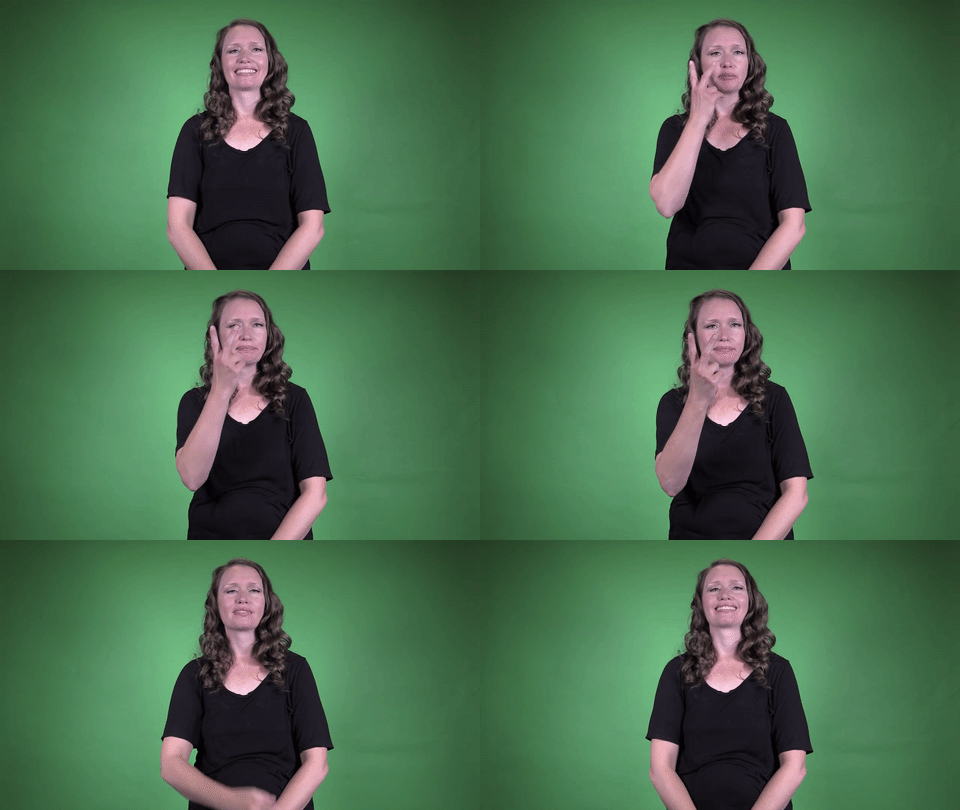
The sign for SEE in ASL involves a “V” handshape, made with your dominant hand. The palm faces outward, and the fingertips of the “V” start near your eye, usually pointing to the area around your cheekbone. The hand then moves forward slightly, away from the face, indicating the act of visually perceiving something. This sign belongs to a category of ASL verbs known as directional or spatial verbs. These verbs can be modified to show who is seeing whom. For example, you can direct the sign from yourself to another person to indicate “I see you,” or from another person to yourself to mean “You see me.” It’s important not to confuse the sign for SEE in ASL with LOOK-AT or WATCH. Although they are all related to the concept of vision, they differ in context and intensity. LOOK-AT often involves more focus or intention, while WATCH implies sustained viewing, like watching a movie. SEE, on the other hand, is more passive and general, often referring to noticing or perceiving something without deliberate effort. Common errors include using the wrong handshape, such as a “U” instead of a “V,” or incorrect palm orientation. Beginners sometimes overextend the movement, turning it into a gesture that resembles pointing rather than signing. These mistakes can change the meaning or make the sign unclear.
Tips for Beginners3>
Learning the sign for SEE in ASL can be both fun and challenging. One of the first tips is to ensure you’re using the correct handshape. The “V” must be clear and firm, with the fingers slightly spread. This detail is small but essential, as unclear handshapes can lead to misunderstandings. Practice in front of a mirror and focus on the movement from the eye outward. Don’t overdo it—this sign should be smooth and subtle. Exaggerated motion can make the sign look unnatural or even change its meaning. Another helpful tip is to watch videos of native ASL users signing the word in different contexts. This helps you recognize the sign for SEE in ASL in real-life communication and understand its variations. Try pausing the video and mimicking the sign frame by frame. Be patient with yourself. It’s normal to make mistakes, especially when learning new verbs. If you accidentally swap SEE with LOOK-AT, take a moment to review their differences. Repetition and context-based practice are key to developing fluency and accuracy.
Connections to Other Topics
The sign for SEE in ASL connects closely with several other signs and topics within the language. One related sign is LOOK-AT. While SEE is more passive, LOOK-AT implies intention and focus. Understanding their differences helps clarify meaning in conversation. Another important connection is the sign for WATCH. This sign is often used when referring to watching movies or events. Like SEE, it involves the eyes, but with a more prolonged or attentive aspect. Practicing all three signs together can help you understand ASL’s nuanced approach to visual perception. The concept of perception verbs in ASL also ties into grammar. SEE belongs to the family of directional verbs, which can be modified based on the subject and object of the sentence. Learning how to move the sign in space helps enhance your grammatical accuracy. A fourth connection is with the sign for UNDERSTAND. In many ASL conversations, SEE and UNDERSTAND are used together or sequentially, like in the phrase “I see, I understand.” This pairing reflects how visual language and cognitive comprehension often go hand-in-hand in ASL discourse. Lastly, SEE is frequently used in storytelling and descriptive language. When narrating events or sharing experiences, signers often mention what they saw, linking SEE to themes like memory, observation, and emotion. Exploring these narrative uses of the sign for SEE in ASL provides depth to your learning and communication skills.
Lengthy Summary
The sign for SEE in ASL is a foundational visual verb that plays a critical role in both conversational and narrative ASL. Executed with a “V” handshape near the eye and a small outward motion, it represents the act of visually perceiving something. It is used across a wide range of contexts, from casual observation to expressions of understanding. Incorporating the sign into your practice routine is essential for long-term retention. Use mirror work to refine handshape and movement, and engage in recorded signing to self-assess your progress. Signing in context—whether through dialogues or storytelling—helps anchor the sign in meaningful interactions. Advanced drills can further enhance your fluency and flexibility with the sign. Culturally, SEE is deeply embedded in Deaf communication, symbolizing not just sight but also awareness and cognition. It is often used in compound signs and directional structures, reflecting both physical and metaphorical seeing. Regional variations exist, but the core meaning remains consistent across the ASL community. A clear understanding of the sign for SEE in ASL also involves distinguishing it from visually similar signs like LOOK-AT and WATCH. These distinctions are subtle but important and can impact the clarity of your communication. Beginners should pay close attention to handshape, palm orientation, and movement to avoid common errors. This sign connects with broader linguistic themes in ASL, including directional verbs, perception-based vocabulary, and narrative techniques. It often appears alongside signs like UNDERSTAND and LOOK-AT, reinforcing its relevance and frequency in the language. As you continue your ASL journey, make the sign for SEE in ASL a regular part of your practice. Return to it often, use it in different contexts, and don’t be afraid to make mistakes. Each attempt brings you closer to fluency and cultural competence. Keep signing, keep seeing, and keep growing Synonyms: view, observe, watch, notice, perceive Educational resources: Find related learning materials in our course bank! Want more? Check out some of our popular learning activities on the homepage! Need to look up a sign? Use our highly rated dictionary: https://aslinteractive.com/best-asl-dictionary/ Follow us on tiktok: https://www.tiktok.com/@aslinteractive. More social media links at the bottom of this page! Long-tail Keywords: what is the sign for see in ASL, how do you sign see in ASL, ASL sign for see Categories: tags: see in American Sign Language, ASL sight words, visual signs in ASL, ASL vocabulary for seeing, ASL verb signs
Want more? Check out some of our popular learning activities!
ASL Interactive Resources
ASLInteractive YouTube Channel
Follow us on tiktok: @aslinteractive.com
Follow us on Instagram: aslinteractive
Facebook page: aslinteractive
Facebook group: aslinteractive
LInkedIn: ASL Interactive LLC
Twitter: @ASL_interactive
*Some information on this page is AI-generated. AI can make mistakes. Please check the information.
Responses