Sign for HOW in ASL | ASL Dictionary

Definition: A question asking about the manner or way something is done.

Sign for HOW in ASL

YouTube player

Practice Activities:

To build confidence using the sign for HOW in ASL, start by practicing it in isolation. Stand in front of a mirror and repeat the sign slowly, paying attention to the orientation and motion of the hands. Then speed up gradually to match natural signing pace. Practice both with and without a mirror to increase fluidity and self-awareness.

Once you’re comfortable with the sign, begin using it in simple questions. Try signing common sentences like “HOW are you?”, “HOW do you feel?”, or “HOW do you sign that?”. Repeat them several times while focusing on facial expressions, which are essential to conveying tone and intent in ASL.

Use flashcards to match questions starting with HOW to appropriate responses. For example, sign “HOW do you make coffee?” and sign a brief, visual response in ASL. This pairs vocabulary with real-world context, reinforcing meaning. If you have a partner, take turns asking and answering different HOW questions to build conversational fluidity.

Try storytelling exercises using the sign for HOW in ASL. Create a short personal story and include questions like “HOW did that happen?” or “HOW did you feel?”. Pause and put emphasis on HOW each time it comes up. This helps create comfort using the sign naturally in narrative format.

Challenge yourself with “question of the day” journaling in ASL. Record yourself signing one HOW-based question each day and then respond in ASL. Review your videos to self-monitor progress and refine clarity.

For a group activity, role-play interviews or advice situations. One person asks a HOW question while the other answers, switching roles after each round. This exercise increases spontaneity and strengthens understanding of the sign for HOW in ASL through real-time interaction.

Cultural Context:

In American Sign Language, understanding how to use the sign for HOW in ASL goes beyond just handshapes. It connects deeply with Deaf culture and the values of respectful communication. The sign for HOW in ASL is often used to begin polite inquiries, reflecting the Deaf community’s emphasis on respectful and clear interactions.

When using the sign for HOW in ASL, it’s important to consider facial expressions and body language. These non-manual markers are a vital part of ASL grammar and serve to convey tone, emotion, and intent. Unlike spoken languages, ASL fully integrates facial expressions into its structure, making communication more expressive and culturally rich.

ASL users typically emphasize clarity and visual accuracy when using signs. The sign for HOW in ASL, in particular, often shows up in phrases that ask for explanations, methods, or reasons. In Deaf culture, it’s viewed as a respectful way to ask for help or knowledge without assuming authority.

Within the Deaf community, asking questions with the sign for HOW in ASL helps foster connection and shared understanding. These interactions reinforce values of patience, inclusivity, and mutual learning. The use of HOW often bridges gaps between people of different signing abilities and backgrounds.

Different contexts or settings might influence how the sign for HOW in ASL is used. For example, a signed conversation at a formal event might present this sign more slowly and clearly, while casual conversations allow for quicker movements. These variations reflect the adaptability and nuance of ASL in different cultural spaces.

The sign for HOW in ASL is often paired with other signs to create full sentences or compound questions. In Deaf culture, communication often follows topic-comment structure, and starting with how respects this linguistic flow. This structure promotes comprehension and shows cultural alignment with the language’s natural rhythm.

Misusing the sign for HOW in ASL or overusing it without context can lead to misunderstandings. Cultural context reminds signers to match their signs with appropriate non-verbal cues and purposeful intent. In ASL, every sign carries weight, and HOW is no exception—it belongs to a broader system of respect-driven expression.

Being aware of the cultural nuances tied to the sign for HOW in ASL improves signer communication skills and builds better community relationships. The Deaf community shows deep appreciation for those who learn and respect the language’s functions and cultural rules. Using HOW correctly is more than memorizing handshapes—it’s about participating in a respectful, vibrant culture.

Language learners and native signers alike might explore how the sign for

Extended Definition:

The sign for HOW in ASL is a fundamental part of communication in American Sign Language. It is used frequently when asking questions, especially open-ended ones that invite more than a yes or no answer. Understanding how to perform and recognize this sign is a crucial step in developing conversational fluency in ASL.

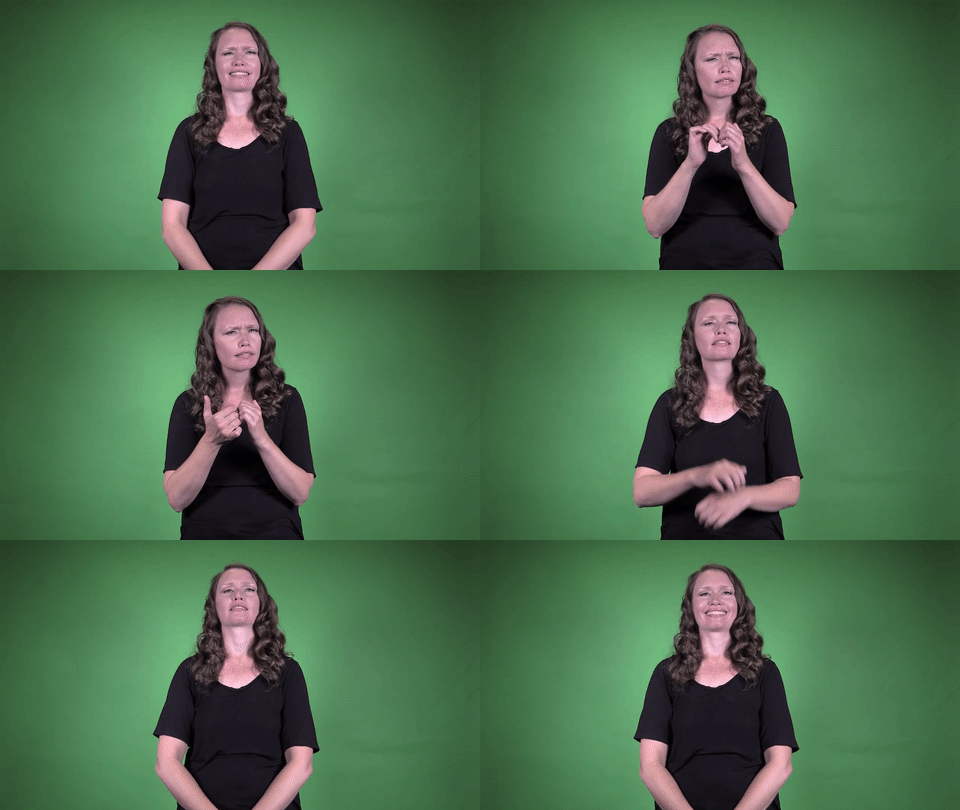
To produce the sign for HOW in ASL, start by bringing both hands together in front of you in a cupped shape, with knuckles touching and palms facing downward. Then, twist one hand slightly forward while maintaining contact. This slight twisting movement is what gives the sign its characteristic look and conveys the meaning of inquiring or requesting an explanation.

The sign is commonly used at the beginning of questions, such as how are you, how do you feel, or how does this work. Because of its versatility, the sign for HOW in ASL appears in many everyday conversations. The movement and intent behind the sign can also shift slightly depending on the question being asked.

Facial expressions play a significant role when signing this term. Raised eyebrows and a curious expression strengthen the meaning and indicate you are asking a question. In ASL, non-manual signals like these are just as important as handshapes and motion.

In casual conversation, native signers may simplify or vary the sign slightly depending on context or speed. However, the core hand and wrist movements remain the same. When learning ASL, consistency in forming the basic version of the sign is ideal until comfort and fluency increase.

The sign for HOW in ASL is also vital in storytelling, interviews, and presentations. It encourages deeper responses and promotes more natural flow in signed dialogue. In addition to personal interaction, it appears in educational materials to teach questioning skills and comprehension.

Kids learning ASL often come across this sign early in their vocabulary lessons because it leads to curiosity and further expression. Teachers and parents use this sign during learning activities to encourage questions and deeper thinking.

Since ASL is a visual language, videos and animated demonstrations often help learners grasp the smooth motion of the sign for HOW in ASL. Watching fluent signers use the sign in context helps improve understanding and retention of its use and meaning.

This sign is essential in both formal and casual communication. You’ll see it used in signed interviews, classroom discussions, and even video content shared across social media platforms. The sign for HOW in ASL bridges questions to answers and helps conversations flow meaningfully.

Learning this sign opens the door to a wider range of questions in AS

Synonyms: in what way, by what method, by what means, in what manner, how-to

Educational resources: Find related learning materials in our course bank!

Want more? Check out some of our popular learning activities on the homepage!

Need to look up a sign? Use our highly rated dictionary: https://aslinteractive.com/best-asl-dictionary/

Follow us on tiktok: https://www.tiktok.com/@aslinteractive. More social media links at the bottom of this page!

Long-tail Keywords: what is the sign for how in ASL, how do you sign how in American Sign Language, how to sign how in ASL

Categories:

tags: how in ASL, ASL question signs, learning ASL basics, American Sign Language grammar, common ASL phrases

Parameters

*Handshape*:

The handshape for the sign for HOW in ASL involves both hands in bent “B” or curved “5” handshapes. The knuckles of the hands touch while the fingers stay curved and point slightly downward. This configuration allows for the smooth rolling or twisting motion that characterizes the sign for HOW in ASL .

This handshape is essential to the fluid movement that conveys the meaning. It helps express the inquisitive or seeking nature of the sign for HOW in ASL, which is often used to ask about method or condition.

*Palm Orientation*:

In the sign for HOW in ASL, both hands are in curved “B” handshapes and placed together at the knuckles, with the fingertips pointing slightly downward. The palm orientation begins with the palms facing down and slightly toward each other.

As the movement happens, the dominant hand twists forward slightly, changing the palm orientation so that the palm partially faces the signer. This fluid motion is essential in conveying the sign for HOW in ASL clearly.

*Location*:

The sign for how in ASL is made in the area directly in front of the chest. Both hands begin in curved “B” handshapes, knuckles touching and palms angled slightly toward the body. The hands are positioned just below the collarbone, creating a symmetrical shape at the center of the upper torso.

When forming the sign for how in ASL, the movement begins close to the chest and flows outward as the hands rotate forward. This location allows for a clear, fluid motion that enhances the expressive quality of the sign while maintaining visual clarity for the viewer.

*Movement*:

To produce the sign for HOW in ASL, position both hands in the “bent hand” shape (like the top of a puppet’s mouth) and place the knuckles of the hands together so they curve inward. Rotate the dominant hand slightly forward in a small twisting motion away from the other hand, like you’re turning a knob.

The movement for the sign for HOW in ASL should feel smooth and deliberate, reflecting an inquiry or curiosity. Facial expression plays a big role—eyebrows raised helps show the intent of asking “how?” in ASL.

*Non-Manual Signals*:

The non-manual signals for the sign for HOW in ASL typically include a slight forward body lean and raised eyebrows, especially when used in a question. A curious or inquisitive facial expression helps clarify intent.

Head tilt is often subtle but adds emphasis when asking “how” something is done or how someone is feeling. The non-manual cues are essential to convey the full meaning and context of the sign for HOW in ASL .

*Prosody, Dominant/Non-Dominant Hand*:

The sign for HOW in ASL uses both hands in a symmetrical motion. The dominant and non-dominant hands are formed in curved “C” handshapes, knuckles touching, with fingertips pointing downward initially. The hands rotate slightly forward so the fingertips end up pointing outward and slightly upward, indicating a questioning or inquisitive tone.

This movement in the sign for HOW in ASL expresses a sense of curiosity or request for explanation . It’s often accompanied by raised eyebrows and tilted head when forming a yes-no or wh- question.

Tips for Beginners:

When learning the sign for HOW in ASL, it’s important to focus on the palm orientation and movement. The sign is made by bringing both bent hands together at the knuckles with the fingers loosely curled, then slightly twisting them forward as if showing how something opens or turns. This movement should be deliberate but smooth, not rushed or stiff.

One essential tip for beginners is to ensure their hands are not too tight. Maintaining flexibility in the fingers creates a more natural look, which is key to clarity. Overly rigid hands can make the sign appear forced or unclear to a fluent signer. Relax your hands and practice in front of a mirror to develop a sense of comfort and smoothness.

Another helpful strategy for mastering the sign for HOW in ASL is to watch native ASL users sign it in context. Seeing how it’s used in questions or rhetorical constructions will help you understand the natural flow. The expression on your face matters too—slightly raising your eyebrows can contribute to the meaning, especially when asking a question.

A common mistake is signing HOW too quickly or without proper movement. Try breaking the movement into two parts when practicing—bringing the hands together, then twisting forward. This helps learners get used to the nuance of movement without rushing.

Also remember that HOW can change slightly depending on the type of sentence you’re signing. It may look slightly different when used rhetorically versus in a typical question. The best way to catch these subtle changes is through consistent exposure to fluent signers and practice.

Take advantage of ASL video resources and slow-motion apps to analyze the movement more carefully. By slowing it down, you catch details you might miss in real time. With patience and daily practice, signing HOW will become automatic and natural.

Connections to Other topics:

The sign for HOW in ASL plays a key role in forming questions and is foundational in constructing WH-questions such as “how are you?”, “how much?”, or “how do you feel?”. It builds semantic bridges to other WH-words like WHO, WHAT, and WHY, which are essential in both casual and formal signing conversations. Because these WH-signs often appear at the end of sentences in ASL syntax, learners can group them together to understand question formation better.

This sign also connects to more complex or derived expressions like HOW-MANY and HOW-LONG, which are formed by combining HOW with signing for quantity or duration. For example, the compound sign HOW-MANY begins with the same handshape as HOW but flows into an open-handed motion suggesting counting or revealing, signifying “how many” of something. These combinations help you expand vocabulary and communicate more abstract or specific ideas fluently.

In storytelling or expressive contexts, the sign for HOW in ASL can be slightly modified in its non-manual markers, such as facial expressions and head tilts, to express nuance or emotional tone. For instance, signing HOW with a squinted eyebrow can imply confusion, while an exaggerated movement can indicate frustration or desperation. This highlights the importance of affect and intention in ASL grammar.

Additionally, the sign for HOW in ASL also makes it easier to discuss methods or processes, such as in educational or professional settings. Phrases like HOW-TO or HOW-WORK are common when giving instructions or describing procedures. When combined with directional or spatial signing, it supports concept clarity, especially when explaining steps in a sequence or the way something functions .

Whether introducing questions, elaborating on quantity, or discussing methods, the sign for HOW in ASL is central to dynamic conversations and deeper comprehension of language structure.

Summary:

The sign for HOW in ASL is expressed using both hands formed into loose letter C handshapes, knuckles touching and palms facing downward. The hands are placed in front of the chest, then rotate forward together so that the fingertips first face each other and finally flip to face upward. This subtle but fluid twisting movement visually conveys inquiry and the concept of asking about manner or process.

The sign for HOW in ASL is a core question word frequently used in everyday conversations. It introduces many types of queries, especially about a method or condition. Its versatility makes it essential for constructing meaningful questions in both casual and academic settings.

Culturally, the sign for HOW in ASL reflects the Deaf community’s strong value on clarity and curiosity. It is often used to engage in deeper dialogue or to request explanations. This aligns with Deaf cultural norms that prioritize understanding over ambiguity.

In terms of grammar, the sign for HOW in ASL works as a WH-question word when used at the end of a sentence, often paired with non-manual signals like furrowed brows. For yes/no questions involving this sign, the gesture might be accompanied by raised eyebrows and forward-leaning body posture. These grammatical markers help differentiate a yes/no inquiry from a more exploratory one.

This sign plays a pivotal role in establishing connection between people during conversation. Asking HOW shows a desire to understand, which is vital in forming interpersonal relationships within Deaf culture. In group discussions or storytelling, HOW encourages further explanation and bridges gaps between concepts.

There are subtle variants of the sign for HOW in ASL depending on regional use or emphasis. Some signers only slightly rotate one hand rather than both, depending on personal or regional style. These variations are still considered correct and fluid within fluent ASL usage.

The sign shows an excellent example of iconicity in ASL, where the motion of the hands mimics turning something over to examine it. This visual metaphor aligns with the mental act of inquiry—turning over an idea or seeking a deeper understanding. The symmetry and smooth motion reinforce the open-ended nature of a HOW question.

The sign for HOW in ASL also features in compound signs or phrases like HOW-MANY or HOW-LONG, adding layers of meaning. These sign clusters demonstrate the sign’s flexibility as a base unit in sentence formation. Combining HOW with other signs modifies entire structures to communicate nuanced ideas.

Linguistically, it falls under the category of interrogatives, playing a crucial role in sentence types and clause structures. It reflects the visual-spatial grammar of ASL, where meaning is conveyed not only through handshapes but through space, movement, and facial expressions. Its placement in a sentence often aligns with ASL’s topic-comment structure, especially in formal or educational contexts.

The sign for HOW in ASL reveals fascinating intersections with cognitive linguistics. In learning and language development, this question word often emerges after basic vocabulary, enriching expressive power. Children and new learners use it to seek clarity, embodying a transition from simple labeling to complex questioning.

Just like spoken interrogatives in English, the sign for HOW in ASL shows pragmatic function. It encourages elaboration or clarification, prompting speakers to expand on details, making it invaluable in academic, medical, or technical discourse. Its use indicates high engagement and interest.

The sign is also important in vocational settings like interpreting, education, counseling, and customer service. Professionals trained in ASL rely on it to understand Deaf clients’ needs and preferences, using HOW to navigate expectations or issue resolution. It is a key tool for facilitating effective, respectful communication.

In education, teachers use the sign for HOW in ASL to check student understanding or offer troubleshooting support. Especially in bilingual ASL-English classrooms, it abets metacognition, asking students to reflect on processes. For learners, the sign models ways to inquire and think critically about steps and procedures.

Discussions about accessibility increasingly include reference to how users ask questions or explain learning strategies. The sign for HOW in ASL becomes a symbol of inclusive inquiry—it embodies the pedagogy of asking questions naturally and visually. It champions engagement across neurodiverse learners and different language levels.

In Deaf history, HOW has featured in educational philosophies and language policy anecdotes. For instance, it was used in early advocacy materials where Deaf signers demanded transparency or inquiry in education methods. It helped pose powerful, culturally resonant questions: How are we taught? How are we included?

HOW is also a foundational sign in ASL poetics and literature. Storytellers use it not just to ask, but to build rhythm and flow in narrative. The graceful arc of the sign can frame suspenseful questions or emotional wonderings in performance art.

The question of HOW is cross-culturally universal, but the sign for HOW in ASL carries its own distinct visual and cultural character. It emphasizes motion, mirroring a foundational value of sign languages—the integration of movement and meaning. Watching this sign in context reveals how ASL users negotiate

Want more? Check out some of our popular learning activities!

ASL Interactive Resources

ASLInteractive YouTube Channel

Follow us on tiktok: @aslinteractive.com

Follow us on Instagram: aslinteractive

Facebook page: aslinteractive

Facebook group: aslinteractive

LInkedIn: ASL Interactive LLC

Twitter: @ASL_interactive

*Some information on this page is AI-generated. AI can make mistakes. Please check the information.


Responses