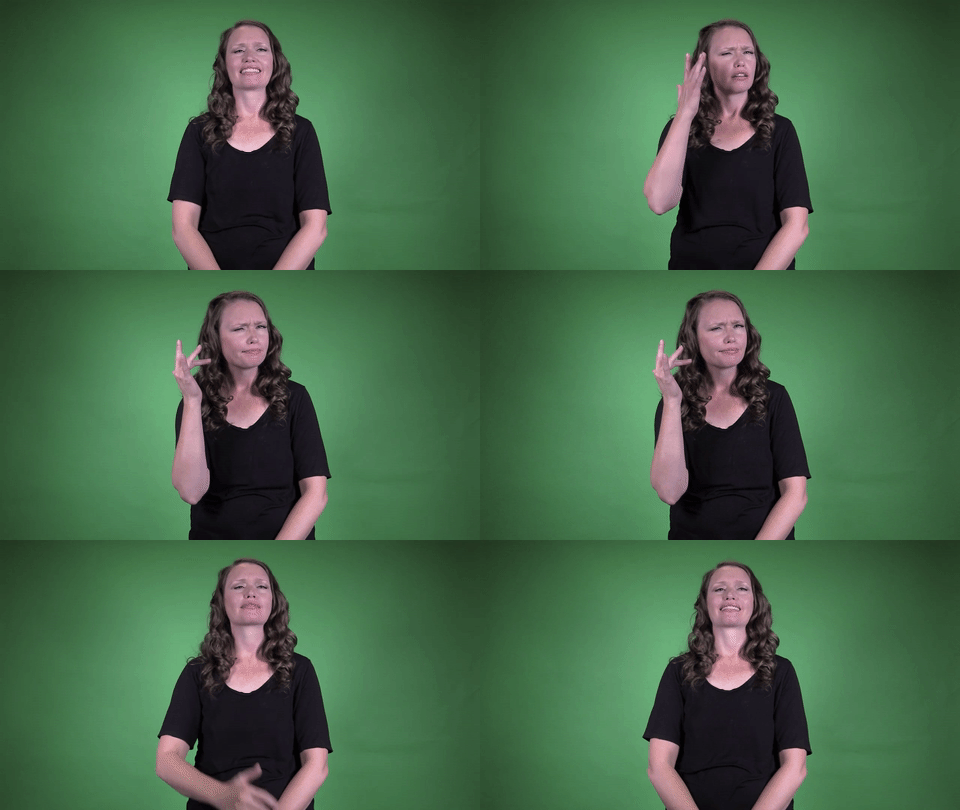
Sign for WHY in ASL | ASL Dictionary

Definition: Asking for a reason or explanation. Sign for WHY in ASL
YouTube player

Practice Activities

One of the most effective ways to master the sign for WHY in ASL is through consistent and diverse practice. Start with mirror work. Stand in front of a mirror and practice the sign slowly, focusing on handshape, location, and movement. This allows you to compare your form with reference videos or instructors’ examples and make real-time corrections. Recorded signing is another useful tool. Use your phone or webcam to record yourself signing full sentences that include the sign for WHY in ASL. Review the videos to ensure clarity and accuracy. Pay attention to your facial expressions, which are crucial for conveying the right tone and grammatical structure in American Sign Language. Signing in context helps reinforce meaning. Practice using the sign for WHY in ASL in everyday conversations, even if you’re just talking to yourself or a study partner. Ask questions like “Why are we going?” or “Why is it raining?” in ASL to anchor the sign in real-life usage. Advanced drills can boost fluency. Try rapid-fire questioning with a partner, using the sign for WHY in ASL in a variety of contexts. For example, your partner signs a sentence, and you respond with a WHY question based on that sentence. This builds your ability to think in ASL and improves conversational speed. Finally, join online ASL groups or attend Deaf events where you can observe and use the sign for WHY in ASL in authentic interactions. Seeing how native signers use the sign in different settings helps solidify your understanding and builds confidence.

SEO Cultural Context

The sign for WHY in ASL reflects the deep connection between language and culture in the Deaf community. This sign is not just a word—it’s a tool for inquiry, learning, and connection. In Deaf culture, asking questions is encouraged as a way to build understanding and community bonds. The sign for WHY in ASL is commonly used in conversation to seek clarification or to express curiosity. Facial expressions play a key role in the meaning of this sign. A raised eyebrow signals a yes/no question, while a furrowed brow often accompanies the sign for WHY in ASL when used to ask open-ended questions. These non-manual signals are essential and culturally embedded in ASL grammar. There may be slight regional variations in how the sign for WHY in ASL is executed. Some signers end the sign with the Y-handshape near the head, while others may drop the hand slightly more as they wiggle the middle finger. These differences are not errors but reflect regional or generational variation within the Deaf community. Deaf etiquette emphasizes the importance of visual clarity and respectful questioning. When using the sign for WHY in ASL, always maintain eye contact and use expressive facial grammar. In classrooms, social gatherings, or storytelling, the sign is frequently used to engage others and invite deeper dialogue.

Extended Definition

The sign for WHY in ASL typically begins with the dominant hand touching the forehead with the fingers extended, then moving away while the middle finger wiggles into a Y-handshape. This motion visually represents the action of thinking and questioning. It’s a dynamic, expressive sign that conveys a sense of inquiry. This sign is a WH-question word, which is an essential category in ASL grammar. WH-questions include what, where, who, when, why, and how. All of these questions share similar facial expressions—usually a furrowed brow and a slight tilt of the head. A common mistake is using a flat facial expression or incorrect hand movement. Without the proper facial grammar, the sign for WHY in ASL may be misunderstood or lose its intended meaning. Some beginners also confuse it with the sign for BECAUSE, which involves a similar movement but ends with a different handshape and context. Another error is overextending the movement or using the wrong starting location. The sign should begin at the forehead, not the cheek or temple. Precision in handshape, motion, and facial expression is key to clear communication. Understanding the nuances of the sign for WHY in ASL helps learners avoid these pitfalls and develop more natural, fluent signing skills. It also builds their ability to form complex questions and engage in deeper conversations.

Tips for Beginners

For those just starting to learn the sign for WHY in ASL, it’s important to focus on both the hand movement and facial expression. Start slow and practice in front of a mirror to ensure your middle finger wiggles correctly as your hand moves from the forehead outward into a Y-handshape. One common beginner mistake is neglecting facial grammar. Without the right expression—usually a furrowed brow—the sign for WHY in ASL may not register as a question. Think of your face as part of the sentence; it works hand-in-hand with the sign. Another tip is to avoid rushing. Many learners try to speed through the motion, which can make the sign unclear. Take your time to learn the fluid motion and correct hand positioning before increasing speed. Consistency is key. Practice the sign for WHY in ASL daily by incorporating it into your routine. Ask yourself “why” questions throughout the day, such as “Why am I hungry?” or “Why is the dog barking?” This creates muscle memory and builds your confidence. Lastly, don’t be afraid to make mistakes. Learning ASL is a journey, and every error is a step toward fluency. Use feedback from teachers, peers, or video recordings to refine your sign for WHY in ASL and grow in your skills.

Connections to Other Topics

The sign for WHY in ASL is closely related to other WH-question signs. For example, the sign for WHAT involves moving both hands in front of the body with palms up and a puzzled expression. Like the sign for WHY in ASL, it requires strong facial grammar to convey the question clearly. Another related sign is HOW, which involves a twisting motion of the hands and is used to inquire about methods or processes. These signs are often grouped together in ASL education because they form the foundation of asking questions and gathering information. The sign for BECAUSE is also connected. While the movement starts similarly to the sign for WHY in ASL, it ends in a different handshape and is used to provide explanations rather than ask questions. Understanding the distinction helps avoid confusion in conversation. The topic of ASL sentence structure is also relevant. In ASL, WH-questions typically come at the end of the sentence. For example, you’d sign “YOU GO WHERE” instead of “Where are you going?” This grammar rule applies to the sign for WHY in ASL as well. Finally, non-manual signals are an essential concept tied to the sign for WHY in ASL. These include facial expressions and head movements that give additional meaning to the sign. Learning to use these effectively enhances your overall fluency and comprehension in ASL.

Lengthy Summary

The sign for WHY in ASL is a cornerstone of question-based communication in American Sign Language. It begins with the fingers touching the forehead and ends with a Y-handshape moving outward, accompanied by a furrowed brow. This expressive sign is fundamental for asking questions, seeking clarification, and engaging in meaningful dialogue in the Deaf community. Culturally, the sign for WHY in ASL reflects the Deaf value of direct communication and visual clarity. It’s used in a wide range of settings—from classrooms and conversations to storytelling and debates. Understanding the role of facial expressions and regional variations enhances your ability to use the sign authentically and respectfully. Practicing the sign for WHY in ASL through mirror work, video recording, and real-world usage builds muscle memory and boosts confidence. Beginners should focus on accurate handshape, movement, and non-manual signals. Avoiding common mistakes like flat facial expressions or incorrect hand placement will lead to clearer communication. The sign for WHY in ASL connects to a broader network of WH-questions, grammatical rules, and related vocabulary. Learning these connections deepens your understanding of how ASL functions as a visual language. It also empowers you to ask and answer questions more naturally. Whether you’re new to ASL or expanding your vocabulary, the sign for WHY in ASL is a powerful tool for communication. Keep practicing, stay curious, and immerse yourself in the language. Every question you ask brings you one step closer to fluency . Synonyms: cause, reason, rationale, motive, explanation Educational resources: Find related learning materials in our course bank! Want more? Check out some of our popular learning activities on the homepage! Need to look up a sign? Use our highly rated dictionary: https://aslinteractive.com/best-asl-dictionary/ Follow us on tiktok: https://www.tiktok.com/@aslinteractive. More social media links at the bottom of this page! Long-tail Keywords: Categories: tags: why in sign language, ASL question words, emotions and feelings in ASL, asking questions in ASL, ASL for beginners

Want more? Check out some of our popular learning activities!

ASL Interactive Resources

ASLInteractive YouTube Channel

Follow us on tiktok: @aslinteractive.com

Follow us on Instagram: aslinteractive

Facebook page: aslinteractive

Facebook group: aslinteractive

LInkedIn: ASL Interactive LLC

Twitter: @ASL_interactive

*Some information on this page is AI-generated. AI can make mistakes. Please check the information.  

Responses