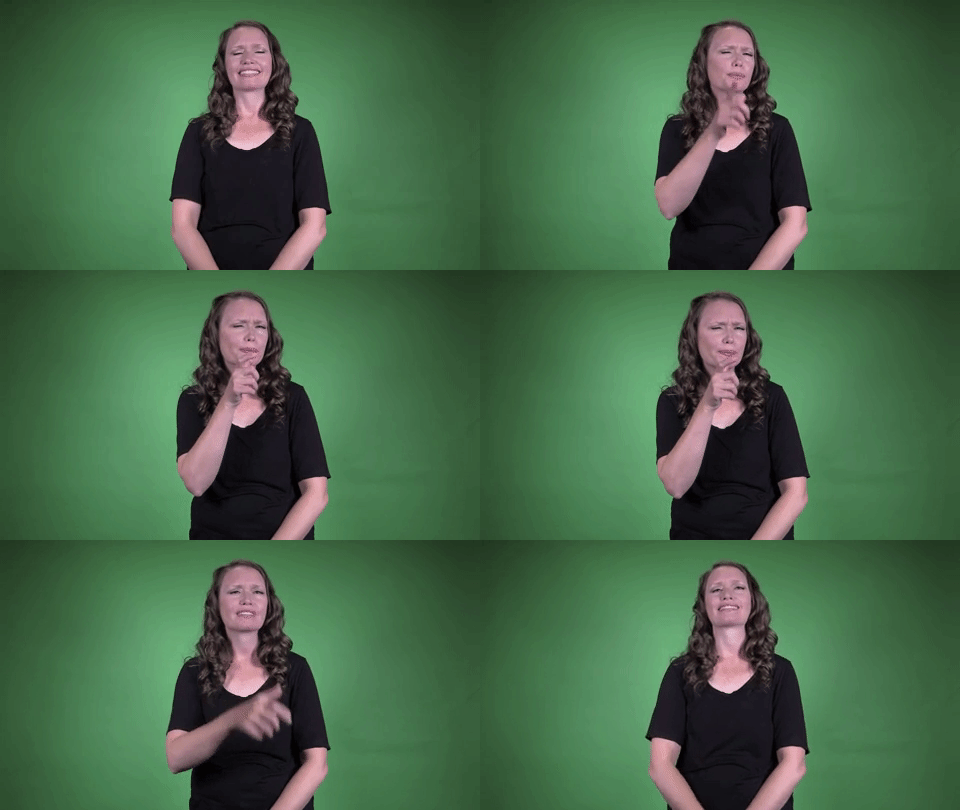
Sign for WHO in ASL ‍ | ASL Dictionary

Definition: Asking about the identity of a person. Sign for WHO in ASL ‍
YouTube player

Practice Activities

Learning the sign for WHO in ASL can be both fun and productive with a variety of

Practice Activities

. Start with mirror work to check handshape, facial expression, and movement. Face a mirror and sign WHO multiple times, paying attention to your index finger placement and the movement near your chin. This visual feedback helps reinforce muscle memory and accuracy. Recorded signing is another strong tool. Use your phone or webcam to record yourself signing WHO in a full sentence or question. Watch the video to evaluate your clarity and fluency. You’ll notice minor adjustments you can make more easily when you see your performance from an outside perspective. Signing in context is essential for internalizing the sign for WHO in ASL. Ask questions to a study partner or in a Deaf community setting. For example, sign “WHO your teacher?” or “WHO lives here?” Using the sign in real conversations helps develop natural rhythm and reinforces grammar. Advanced drills include speed drills and facial expression control. Try signing WHO in rapid succession with other WH-question signs like WHAT, WHERE, and WHY. This builds fluency and helps you distinguish between signs. You can also practice varying your facial expressions to match different emotional tones—curiosity, surprise, or confusion—while maintaining clear hand movements.

SEO Cultural Context

The sign for WHO in ASL plays a central role in asking questions and initiating dialogue. In Deaf culture, asking WHO is more than just information gathering—it’s a way to show genuine interest and connect with others. The sign is used frequently in social and educational settings, from casual chats to formal presentations. Facial expressions are a vital part of the sign for WHO in ASL. A raised eyebrow signals a yes/no question, while a furrowed brow shows that you’re asking a WH-question like WHO. These facial expressions are not optional; they are grammatical markers in ASL. Without them, your question may be misunderstood or appear incomplete. Regional variations exist, though they are subtle. In some parts of the U.S., the sign for WHO includes a slight forward movement of the index finger, while in others the finger may stay stationary and the facial expression does the work. Both are correct, but understanding these nuances helps you communicate effectively with a diverse group of signers. In real-life interactions, the sign for WHO in ASL is used in introductions, storytelling, interviews, and classroom settings. For instance, when you’re learning about a person’s family, you might ask, “WHO is your brother?” or “WHO helped you?” The context always shapes the tone and delivery of the sign.

Extended Definition

The sign for WHO in ASL begins with the dominant hand forming the “L” handshape. Place the tip of your thumb on your chin and bend your index finger once or twice. It’s a subtle movement, so precision matters. Your facial expression should match the question form, typically with eyebrows down and a focused look. Some learners confuse the sign for WHO in ASL with the sign for WHY or HOW, particularly because they all involve the face or chin area. To differentiate, WHO has a distinct “L” handshape with a movement of the index finger, while WHY uses a “Y” handshape with a different motion near the forehead. Another error is omitting the necessary non-manual signals. Signing WHO without the correct facial expression can lead to miscommunication. Always remember that in ASL, the face is part of the grammar. Practice combining the hand movement with the correct expression to ensure your question is clear and culturally appropriate. Pronouns in ASL are often established before WH-questions. For example, you might sign “HE WHO?” or “SHE WHO?” to clarify the subject. Context is key, and the sign for WHO in ASL adjusts slightly depending on the sentence structure and flow.

Tips for Beginners

Learning the sign for WHO in ASL can feel overwhelming at first, but with consistent practice, it becomes second nature. Watch videos of native signers using the sign in different contexts. Pay attention to how they incorporate facial expressions, hand movement, and sentence flow. One common mistake is misplacing the thumb or using the wrong handshape. Beginners sometimes substitute a “1” handshape or touch too far down the chin. To avoid this, slow down and practice the correct placement using a mirror or with a tutor who can provide real-time feedback. Another pitfall is forgetting facial grammar. New learners often focus so much on the hand that they forget to engage their face. Think of your face as your second hand—it’s just as important in conveying meaning. Practice asking questions in front of a mirror to train both your hands and your face. Don’t be afraid to ask for feedback. Deaf community members are often more than willing to help learners improve. Use every opportunity to sign in real conversations. The more you use the sign for WHO in ASL in natural settings, the more comfortable and fluent you’ll become.

Connections to Other Topics

The sign for WHO in ASL connects closely with other WH-question signs like WHAT, WHERE, WHEN, WHY, and HOW. These signs form a core group of vocabulary that learners use constantly in questions and conversations. Practicing them together strengthens your grasp of ASL grammar and structure. Another related concept is non-manual markers. These facial expressions are essential in distinguishing question types. Learning how to match your facial expression to each question sign is a foundational skill in ASL communication. Pronouns and indexing are also related topics. When you ask WHO, you’re often referring to someone already mentioned or pointed out. Learning how to establish referents through pointing or name signs enhances your ability to ask clear and meaningful questions. Fingerspelling is another area to explore. Sometimes, you may fingerspell a name and then sign WHO to ask about that person. Mastery of fingerspelling helps bridge gaps when names or specific identifiers are not yet known in sign. ASL sentence structure is crucial when using the sign for WHO in ASL. Typically, WH-question signs appear at the end of the sentence, especially in casual conversation. Understanding how to correctly order your signs gives your questions clarity and fluency.

Lengthy Summary

The sign for WHO in ASL is a foundational element of communication in American Sign Language. It combines a specific handshape, a subtle movement, and a precise facial expression. When learning this sign, it’s essential to master all three components to ensure accurate and culturally appropriate usage.

Practice Activities

such as mirror work, recorded signing, and contextual conversations help reinforce the sign for WHO in ASL in both form and function. Advanced drills build fluency and prepare you for real-life conversations. These exercises help you internalize the sign so it becomes an automatic part of your signing vocabulary. Culturally, the sign for WHO in ASL is deeply embedded in the values of Deaf communication. Respect for clear, expressive signing and proper facial grammar reflects the importance of visual clarity in Deaf culture. Regional differences may affect the sign slightly, but the core components remain consistent and widely understood. Understanding related signs and grammar structures enhances your command of the language. Whether you’re asking WHO someone is, WHO did something, or WHO is responsible, the sign fits into a larger framework of WH-questions, pronouns, and sentence flow. These connections enrich your understanding and improve your ability to communicate effectively. For beginners, the key is patience and consistency. Mistakes are part of the learning process. Focus on correct handshape, movement, and facial expression. Use real-life practice opportunities to build confidence. The more you use the sign for WHO in ASL, the more natural it becomes. In summary, mastering the sign for WHO in ASL opens the door to more complex conversations and deeper connections in the Deaf community. It’s more than just a vocabulary word—it’s a tool for engagement, curiosity, and human connection. Keep practicing, stay curious, and remember: every sign you learn brings you one step closer to fluency Synonyms: who, whom, whose, which person, that person Educational resources: Find related learning materials in our course bank! Want more? Check out some of our popular learning activities on the homepage! Need to look up a sign? Use our highly rated dictionary: https://aslinteractive.com/best-asl-dictionary/ Follow us on tiktok: https://www.tiktok.com/@aslinteractive. More social media links at the bottom of this page! Long-tail Keywords: Categories: tags: ASL Pronouns, ASL Question Words, Basic ASL Vocabulary, People in ASL, WH-Questions in ASL

Want more? Check out some of our popular learning activities!

ASL Interactive Resources

ASLInteractive YouTube Channel

Follow us on tiktok: @aslinteractive.com

Follow us on Instagram: aslinteractive

Facebook page: aslinteractive

Facebook group: aslinteractive

LInkedIn: ASL Interactive LLC

Twitter: @ASL_interactive

*Some information on this page is AI-generated. AI can make mistakes. Please check the information.  

Responses