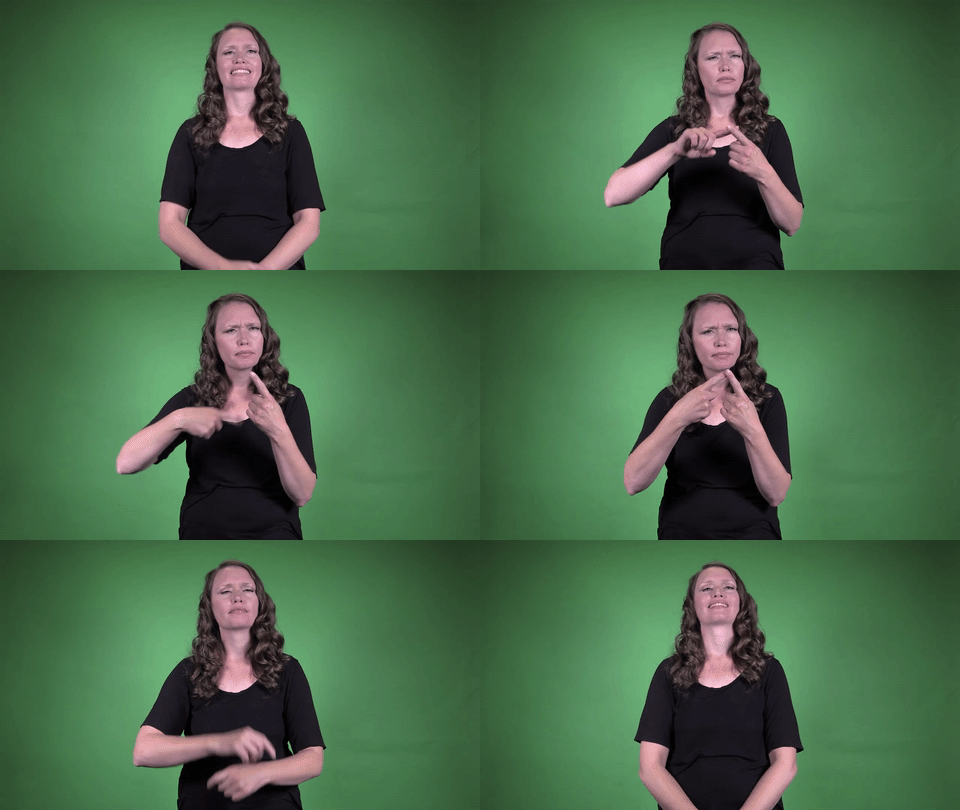
Sign for WHEN in ASL | ASL Dictionary

Definition: At what time. Sign for WHEN in ASL
YouTube player

Practice Activities

One of the most effective ways to master the sign for WHEN in ASL is through consistent and varied practice. Begin by standing in front of a mirror and practicing the movement slowly. This helps you focus on handshape, palm orientation, and facial expression, which are all key components of accurate signing. Record yourself signing the word in different sentence structures. For example, ask, “When will we meet?” or “When is your birthday?” Watching your own videos allows you to identify errors and track your progress over time. It also builds confidence in your expressive abilities. Sign the word in context during your daily routines. Ask yourself or others questions using the sign for WHEN in ASL while planning events or discussing schedules. Practicing in real-life contexts strengthens memory and fluency. For more advanced learners, engage in receptive drills. Ask a study partner to sign questions using WHEN and try to respond quickly and accurately. You can also watch ASL videos or vlogs and try to identify each time the sign for WHEN in ASL appears. Mimic the sign immediately after seeing it to build speed and precision.

SEO Cultural Context

Understanding the sign for WHEN in ASL involves more than just hand movement—it also requires cultural awareness. In Deaf culture, time-related questions are often used to establish context before diving into the main topic. This reflects a broader communication norm in ASL where setting the scene is important. The sign for WHEN in ASL may show slight regional variations, especially in speed or facial expressions. However, the core motion—an index finger circling another index finger and landing back on it—remains consistent. Be aware that different signing communities might use facial expressions more or less intensively depending on local norms. In everyday Deaf interactions, asking WHEN something will happen is crucial for coordinating events, planning meetings, or simply sharing details about daily life. Because facial grammar in ASL conveys tone and intent, your facial expressions when asking WHEN can indicate curiosity, urgency, or even skepticism. This emotional layering is a valued part of Deaf communication norms.

Extended Definition

The sign for WHEN in ASL is categorized as a wh-question sign, typically accompanied by a furrowed brow to indicate a question. To produce the sign correctly, extend your non-dominant index finger and hold it steady in front of you. Then, take your dominant index finger and make a small clockwise circle in the air before bringing it to touch the tip of the non-dominant finger. The motion resembles a hand on a clock, visually reinforcing the concept of time. It’s important to distinguish the sign for WHEN in ASL from similar signs such as TIME or FUTURE. TIME involves tapping the wrist, where a watch might be worn, while FUTURE moves the hand forward from the side of the head. Confusing these signs can lead to misunderstandings, so practicing them side by side can help reinforce the differences. A common error is to move both fingers or to make the circling motion too large or too fast. These small changes can alter clarity. The sign is most readable when done with controlled, deliberate motion. Make sure your non-dominant finger remains steady and your facial expression clearly indicates you are asking a question.

Tips for Beginners

If you’re just starting to learn the sign for WHEN in ASL, don’t worry about speed at first—focus on form. Many beginners rush the circling motion or forget the final touch that completes the sign. Practicing slowly helps build muscle memory and accuracy. Use visual cues to remember the motion. Think of your dominant finger as a clock hand circling around to indicate time. This mental image can help reinforce the concept and shape of the sign. You can also pair it with flashcards or digital apps that allow you to see the sign in motion. Another tip is to always pair the sign with the proper facial expression. In ASL, wh-questions like WHEN require a furrowed brow. Practicing in front of a mirror helps you become aware of your facial grammar, which is essential for clear communication. Be patient with yourself. Mastery of the sign for WHEN in ASL doesn’t happen overnight. Celebrate small victories, such as using the sign correctly in a sentence or recognizing it in a video. These moments build confidence and encourage continued learning.

Connections to Other Topics

The sign for WHEN in ASL connects closely to other time-related vocabulary. One related sign is TIME, which is made by tapping the wrist. This sign is often used in conjunction with WHEN to ask more detailed questions like “What time is the meeting?” Another related concept is the sign for FUTURE, which involves a forward motion from the side of the head. This sign helps place events on a timeline and is often used after asking WHEN something will happen. Understanding how WHEN fits into broader temporal structures enhances your fluency. The sign for PAST is also relevant. It moves from the shoulder area backward, indicating something that has already occurred. Combining WHEN with PAST allows you to ask “When did that happen?” which is a common question in both everyday and narrative contexts. The grammatical structure of ASL also plays a role here. In ASL, time indicators like WHEN often come at the beginning of a sentence to set the frame. This differs from English and helps learners understand how ASL structures information. Lastly, the sign for SCHEDULE or CALENDAR is frequently used in tandem with WHEN. These signs help organize and clarify responses to questions about time. For example, someone might respond to a WHEN question by referring to their calendar, using both signs in a logical sequence.

Lengthy Summary

Mastering the sign for WHEN in ASL involves more than just learning a hand movement. It requires understanding the grammatical, cultural, and practical layers that enrich the sign’s meaning. From practicing in front of a mirror to engaging in real-life conversations, learners benefit most when they use a variety of techniques to reinforce their skills. The cultural context reminds us that time-related questions serve a vital function in Deaf communication. Knowing how to ask WHEN something will occur is essential for effective planning and relationship-building. Understanding regional differences and respecting facial grammar ensures your question is received clearly and respectfully. The

Extended Definition

clarifies the mechanics of the sign and how it differs from similar signs like TIME, FUTURE, and PAST. Avoiding common errors, such as misplacing the circle or forgetting facial expressions, can elevate your signing from understandable to fluent. Beginners should take heart. The sign for WHEN in ASL is accessible with practice and repetition. Staying mindful of handshape, motion, and facial expression allows newcomers to gain confidence quickly. Encouraging methods like video recording and contextual signing make learning more engaging and effective. Connections to other signs and topics show that WHEN is not an isolated concept. It lives within a broader network of time-based vocabulary and ASL grammar. Understanding this relationship deepens your linguistic competence and makes your communication more natural. The sign for WHEN in ASL is a foundational building block in your ASL journey. It opens the door to richer conversations and more meaningful interactions. Keep practicing in diverse settings, reflect on your progress, and stay curious. With commitment and creativity, your fluency and confidence will grow every day . Synonyms: whenever, as soon as, at the time that, just after, upon Educational resources: Find related learning materials in our course bank! Want more? Check out some of our popular learning activities on the homepage! Need to look up a sign? Use our highly rated dictionary: https://aslinteractive.com/best-asl-dictionary/ Follow us on tiktok: https://www.tiktok.com/@aslinteractive. More social media links at the bottom of this page! Long-tail Keywords: Categories: tags: ASL question signs, ASL time signs, ASL travel vocabulary, ASL conversational phrases, how to ask questions in ASL

Want more? Check out some of our popular learning activities!

ASL Interactive Resources

ASLInteractive YouTube Channel

Follow us on tiktok: @aslinteractive.com

Follow us on Instagram: aslinteractive

Facebook page: aslinteractive

Facebook group: aslinteractive

LInkedIn: ASL Interactive LLC

Twitter: @ASL_interactive

*Some information on this page is AI-generated. AI can make mistakes. Please check the information.  

Responses